
Why it matters
The producer
Decugnano dei Barbi is a family estate in Umbria, central Italy, producing wines under the Orvieto Classico DOC and the broader IGT Umbria designation. Claudio Barbi acquired the property in 1973. The first bottles left the estate in 1978, five years after the family took ownership. Enzo Barbi leads the estate today.
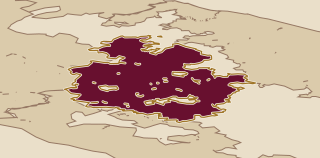
The Orvieto Classico zone sits in southwestern Umbria, around the volcanic plateau above the town of Orvieto, and the name on the label signals a place with a long white wine tradition built on native grape varieties. What makes Decugnano dei Barbi specific within that zone is what lies beneath the vineyard surface: sandy soils still carrying fossil seashells from a sea that no longer exists.
Place and vineyards
Where the wines begin
Umbria is a landlocked region in central Italy, running between Tuscany to the northwest and Lazio to the south. Its wines work within two different legal frameworks: the DOC appellations, of which Orvieto Classico is the most established white wine category, and the IGT Umbria designation, which allows greater flexibility in grape selection and style.
Orvieto Classico historically centres on white wines from native varieties, particularly Grechetto and Trebbiano Toscano, grown on the slopes around the old city. The DOC framework shapes what appears on the label and what goes into the bottle. IGT Umbria wines carry the regional name and allow the producer to work outside the strict DOC variety list. Both designations appear across the Decugnano dei Barbi range.
In the cellar
Vineyards and cellar
Sustainable farming at Decugnano dei Barbi is a practical philosophy applied to the vineyard: the sandy, fossil-rich soils are treated as something to be preserved rather than corrected. Farming decisions follow from that position.
In the cellar, Mare Antico is made with primary fermentation in stainless steel and a small portion fermented in French oak barrels. The stainless steel keeps the wine's mineral and fruit character clean and direct. The oak portion adds weight and a degree of texture without redirecting the wine toward wood-driven flavour. The two fractions are brought together to produce a white with the freshness of tank fermentation and a small measure of complexity from the barrel work.
Wines to know
The range in view
The range sits across two designations. Orvieto Classico DOC wines follow the appellation rules for grape variety and proportion. IGT Umbria wines give the estate more room to move on blend and style.
Mare Antico is the named white. It is made from grapes grown in the fossil-shell sandy soils, fermented primarily in stainless steel with a smaller barrel-fermented portion folded in. This white wine has a clear mineral signature from the soil and enough body from the oak fraction to carry texture through the mid-palate. It carries the character of the place it comes from more directly than a blended, cellar-processed white.