
Why it matters
The producer
José Neiva Correia had already spent more than four decades shaping Portuguese wine when he founded DFJ Vinhos as a family firm in 1998. The company grew fast. Within a few years it was sending 10 million bottles a year to over 50 countries, drawing from five Portuguese wine regions and working across 22 grape varieties. The scale is real: DFJ is not a boutique estate. It is one of Portugal's significant export producers, and it operates with the discipline that scale demands.
The Escada range is built around Touriga Nacional, Portugal's most important red grape. Two tiers cover the range: a standard Touriga Nacional and a Reserva that blends in Touriga Franca and Alicante Bouschet with 14 months of French oak ageing. Both are designed for the international market, and both are made in Lisboa, where the Atlantic keeps conditions cooler and more humid than the grape's Douro homeland.
Place and vineyards
Where the wines begin
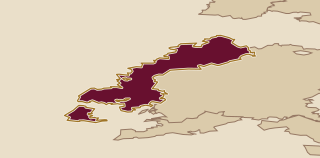
Lisboa is Portugal's westernmost wine region, stretching north from the capital along the Atlantic coast. The ocean is the defining force. Atlantic air moderates summer temperatures and brings consistent humidity through the growing season, producing conditions very different from the hot, dry inland valleys of the Douro or Alentejo. Grapes ripen more slowly here, retaining more natural acidity, and the wines tend toward aromatic lift rather than deep extraction.
Touriga Nacional in Lisboa is a different animal from Touriga Nacional in the Douro. In the Douro, the grape produces dense reds built for long ageing, concentrated by heat and schist soils that restrict water. In Lisboa, the same grape produces a more aromatic, medium-weight red: the perfumed spice and violet character come through clearly, the tannins are softer, and the finish is more approachable on release. The Lisboa appellation on the label signals this cooler, coastal style rather than the concentrated inland version.
In the cellar
Vineyards and cellar
Escada Touriga Nacional is fermented with a two-phase temperature programme: the fermentation rises to 30°C through the first two-thirds of the process, then drops to 20°C for the final phase. The high temperature in the early phase drives extraction and colour development; the lower temperature in the final phase preserves the aromatic compounds that would volatilise at sustained heat. It is a wine with both colour depth and Touriga's characteristic perfumed spice intact.
After fermentation, the wine spends 30 days in extended cap contact. During this period, the cap of grape skins is plunged regularly into the fermenting liquid. This extracts tannins gradually, choosing volume of contact over aggressive pressing, which keeps the tannins soft and velvety rather than grippy. Malolactic fermentation and natural stabilisation complete during this 30-day window, converting the sharper malic acid to softer lactic acid and settling the wine without heavy intervention.
Wines to know
The range in view
Escada Touriga Nacional is the entry point into DFJ's range: a single-grape Lisboa red made from Portugal's most widely planted noble variety. Across the 2020, 2021, and 2022 vintages, the wine shows red cherry and dark fruit on the nose, with Touriga's perfumed violet and spice character persistent from glass to finish. The body is full, the tannins are soft and velvety from the 30-day cap plunge, and the texture is approachable on release. Wine Enthusiast noted the 2020 vintage as ready to drink, with easy texture and red cherry alongside perfumed spice; the 2021 received similar notes, with the grape's aromatic quality dominant and tannins softened by vibrant black fruit and ripe acidity.
Escada 2023, reviewed by USA Wine Ratings at silver medal level, adds aromatic complexity: peppercorn, toasted oak, and dried blueberry alongside fresh cherry and plum, with bright acidity balanced against a soft, fruit-driven finish.
A useful way in
A bottle to begin with
Escada Touriga Nacional is the right first bottle from DFJ Vinhos. It is a Lisboa red built entirely from Touriga Nacional: fermented with a two-temperature programme that preserves aromatic lift, then extracted over 30 days on cap to bring soft, velvety tannins rather than grip. In the glass, violet and dark fruit on the nose, ripe cherry and spice on the palate, a full body without heaviness, and a finish that extends beyond what the price suggests. This is Touriga Nacional on the Atlantic coast, more aromatic and more immediately approachable than the same grape grown in the Douro's inland heat.