
Why it matters
The producer
In 1968 the Di Majo family took ownership of land that had belonged to the Marquises Norante di Santa Cristina and kept the aristocratic name as their label. The estate sits in Campomarino, in the Ramitello district of Molise, a few kilometres from the Adriatic coast and just north of the Gargano promontory. At 123 hectares under vine, Di Majo Norante is the dominant wine operation in this part of the region.
Alessio Di Majo runs the estate today, continuing the work his father Luigi began. Riccardo Cotarella consults on winemaking. The range is anchored by three varieties: Montepulciano and Aglianico for red, Falanghina for white. The Aglianico appears in two distinct bottles, one of them from a vineyard certified organic roughly thirty years ago, long before organic certification carried any commercial weight in this part of Italy.
Place and vineyards
Where the wines begin
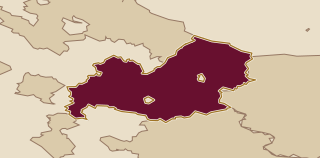
Molise is Italy's second-smallest region and one of its least visible in wine retail. It sits between Abruzzo to the north, Campania to the south, and the Adriatic to the east. Most of the region is hill and inland plateau; the coastal strip near Campomarino is lower and more influenced by sea air than the higher terrain to the west.
The Ramitello district, where the Di Majo Norante vineyards lie, sits at an elevation where the sea breeze moderates summer heat. That cooling effect preserves acidity in both red and white grapes, which matters most for the Aglianico: a variety that builds deep tannin and dark fruit in the south, and needs acidity to keep those elements from feeling heavy. Molise's Terra degli Osci IGT covers the estate's everyday range; the Aglianico bottles carry the DOC designation Molise.
In the cellar
Vineyards and cellar
The estate farms 123 hectares with biological methods throughout and certified organic on the Biorganic plot. Solar power and purified estate water reduce external inputs.
In the cellar, the two tiers of the range are made in genuinely different ways. The Molì wines are steel-only: the Molì Bianco undergoes twelve to twenty-four hours of skin contact before fermentation at a controlled 16 to 18 degrees Celsius, with complete malolactic fermentation softening any sharp edges. The Molì Rosso goes through a long maceration in steel vats, also with complete malolactic fermentation, then three months in bottle before release. That long maceration extracts colour and tannin from the Montepulciano while the Aglianico adds spice and structural weight.
Wines to know
The range in view
The range divides cleanly between an approachable everyday tier and a serious single-variety tier.
Molì Rosso (Terra degli Osci IGT): A blend of 80 percent Montepulciano and 20 percent Aglianico, made entirely in steel. Bright ruby red colour. The nose is fresh and fruity; the palate is full-bodied with a slightly bitter finish that comes from the Montepulciano's natural tannin grip. Straightforward and direct.
A useful way in
A bottle to begin with
Start with the Aglianico Biorganic. It is 100 percent Aglianico from a certified-organic vineyard on the estate, and it shows what the grape does in Molise before oak ageing softens and deepens the picture. Cherry, plum, pepper, and violet on the nose; dry and medium-bodied in the mouth with tannins that are present but not punishing. The acidity keeps it alive across the whole palate. It is also the bottle with the clearest story behind it: a single vineyard, certified organic for thirty years, in a region where almost nobody was farming that way when the decision was made.