
Why it matters
The producer
Raj Parr and Sashi Moorman planted Domaine de la Côte in 2007 on the furthest western edge of the Sta. Rita Hills appellation in Santa Barbara County, California. The six vineyard sites cover 40 acres on geology that was seabed 25 million years ago, positioned seven miles from the Pacific. All wines are made at the Lompoc facility, three miles from the vines.
The proposition here is not Californian abundance. Parr and Moorman set out to make Pinot Noir and Chardonnay that behave more like cold-climate French originals: lower alcohol, firm acidity, mineral character drawn from ancient siliceous and diatomaceous soils. The estate is organic, farmed at vine densities that most California growers associate with Burgundy, and the cellar adds nothing to what the vineyard delivers.
Place and vineyards
Where the wines begin
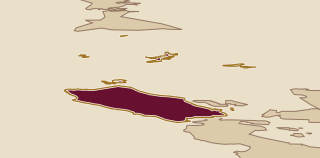
Sta. Rita Hills is an appellation in the transverse ranges of Santa Barbara County, oriented east to west so that ocean air funnels inland through the Santa Ynez Valley. Domaine de la Côte sits at the far western end of this corridor, where the Pacific influence is strongest and temperatures rarely climb above 25°C during the ripening season. The cold restrains sugar accumulation and keeps acidity in the fruit through harvest.
The soils here are siliceous and diatomaceous, formed from compressed marine sediment deposited 25 million years ago. That geology drains sharply, forces vine roots deep, and contributes the mineral thread that runs through the red and white wines alike. On the label, wines carry the Sta. Rita Hills appellation; within the range, individual bottles are named for the vineyard sites they come from.
In the cellar
Vineyards and cellar
Organically farmed vines at 4,000 to 7,000 vines per acre means each vine carries a smaller crop load than California convention allows. Tighter spacing concentrates the fruit, pushes ripeness later, and gives each vine less capacity to compensate for weather stress. California heritage selections traced to Burgundy clones contribute genetic character that standard nursery material does not: finer skins, more aromatic complexity, and a tendency toward red rather than dark fruit in Pinot Noir.
Whole-cluster fermentation uses the full grape cluster, berries and stems together. The stems remain part of the fermenting material, lengthen the fermentation, and introduce a savory, spiced quality alongside the fruit. Fermentation runs without additives and without temperature control, which allows the native yeast population in the vineyard to drive the process. No corrections are made after fermentation. The wines move to barrel and eventually bottle without adjustment.
Wines to know
The range in view
The estate produces single-vineyard Pinot Noir from each of the six sites and Chardonnay as a significant secondary part of the range. The bottles are differentiated by site, not by classification tier, so each bottling reflects a distinct parcel of the 40-acre holding.
Bloom's Field Pinot Noir is the most fully documented of the named bottlings. It shows concentrated black cherry and blackberry, notes of purple plum, and a mineral thread through the fruit that lifts the palate and extends the finish. Concentration and freshness work together rather than against each other, with the acidity carrying the fruit through a long close.
A useful way in
A bottle to begin with
Start with Bloom's Field Pinot Noir. It is a single-vineyard wine from one named parcel within the 40-acre estate, grown on 25-million-year-old seabed, fermented with whole clusters and no additions, and bottled without correction. In the glass it gives concentrated black cherry and blackberry alongside purple plum, with a mineral spine that runs from the mid-palate through a long finish. The acidity holds the concentration in check and gives the wine its length. This is the bottle that puts the estate's argument into the clearest form: cold site, dense vines, ancient geology, whole-cluster cellar work, and nothing added.