
Why it matters
The producer
Giacomo Rallo came from four generations of Sicilian wine traders. In 1983 he and his wife Gabriella made a different move: instead of continuing in the wholesale trade, they founded Donnafugata as an estate producer, anchored by the family's historic cellars in Marsala. Giacomo ran the estate until his death in 2016, and their children José and Antonio now lead it.
The name and the range both carry a certain ambition. From Marsala, the estate spread across the island and out to sea: Pantelleria in 1989, then east to Etna's volcanic slopes at Randazzo, then south-east to the Vittoria area where Nero d'Avola and Frappato grow in the heat. Each territory produces wines under its own appellation logic, but the Pantelleria operation is where Donnafugata has invested most deeply, and where the farming decisions are hardest to replicate.
Place and vineyards
Where the wines begin
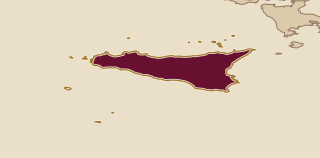
Sicily's four wine territories in this range sit at very different latitudes and altitudes. Western Sicily, centred on the Contessa Entellina estate, is warm, low-lying, and suited to the full-bodied red varieties that produce Mille e Una Notte. Vittoria, in the island's south-east, falls within the Cerasuolo di Vittoria and Frappato di Vittoria DOC zones, where the combination of Nero d'Avola's weight and Frappato's aromatic lift defines the local style. Etna sits at 15 hectares near Randazzo on the northern slope of the volcano, where altitude and volcanic mineral soil push the wines in a cooler direction.
Pantelleria's soils are volcanic and sandy. The volcanic composition appears to have protected the island's vines from phylloxera, the root louse that devastated European vineyards in the late nineteenth century and forced growers to graft their vines onto American rootstock. Ungrafted pre-phylloxera vines still exist on Pantelleria, and Donnafugata has worked deliberately to preserve them.
In the cellar
Vineyards and cellar
On Pantelleria, every vine is farmed by hand. The alberello system, which UNESCO added to its list of Intangible Cultural Heritage, requires workers to crouch at ground level to prune, train and harvest. Vines grow in shallow hollows that channel rainwater to the roots, a technique developed to make the most of a dry island climate. Wire training, which would make mechanical harvesting possible, is not compatible with alberello.
The 53 hectares on Pantelleria include the restored old-vine plot and the experimental biotype vineyard. The old vines, ungrafted and more than a century old, produce smaller crops than younger plantings. Their fruit carries concentration accumulated over decades of slow growth in volcanic sand.
Wines to know
The range in view
Donnafugata's range is structured by territory rather than by price tier. Each appellation produces a distinct wine type that does not have a direct equivalent elsewhere in the range.
From western Sicily's Contessa Entellina estate comes Mille e Una Notte, the flagship red. The wine draws on the warm-climate varieties that dominate the estate's low-lying vineyards.
A useful way in
A bottle to begin with
Ben Ryé Passito di Pantelleria is the right first bottle. It is 100 percent Zibibbo, the island grape grown under the UNESCO-listed alberello system on volcanic sand, made by drying the harvest to concentrate everything the variety offers: apricot, orange blossom, dried fig, and a faint saline edge from the island's soil. The wine matures for five months in tank and at least sixteen in bottle, which gives it more composure than many wines at its sweetness level. Drink it cold, with almond pastry, blue cheese, or alone at the end of a meal. It anchors the estate's Pantelleria work directly and carries the clearest trace of every farming decision made on the island.