
Why it matters
The producer
A family viticultural tradition dating to 1597 still shapes Dr. Bürklin-Wolf, a Wachenheim estate devoted to dry Riesling. Bernhard Bürklin, Wachenheim's town clerk and later mayor, established the family's local holdings. Today, Bettina Bürklin-von Guradze owns the estate, having taken it over in 1990.
The present name came through Luise Wolf's marriage to Dr. Albert Bürklin. The marriage brought vineyards in Wachenheim, Forst, Deidesheim and Ruppertsberg into joint family ownership, creating the geographic base for a range that moves from broad estate blending to named vineyard wines. Riesling is the central grape, and dry fine Rieslings from valuable German vineyards are the house specialty.
Place and vineyards
Where the wines begin
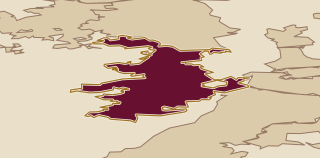
Wachenheim sits in the Pfalz wine-growing region, with the estate's vineyards spread through four Mittelhaardt villages. Estate Riesling blends fruit from across those villages, so its label presents a regional reading of Pfalz Riesling. Village wines narrow the geographic frame, P.C. wines narrow it further, and G.C. wines come from the leading sites. The label sequence therefore moves from a broad regional blend toward a single vineyard and a more concentrated site expression.
The broad Estate Riesling comes from sites in Wachenheim, Deidesheim and Ruppertsberg with clay, limestone, loam and sand. That mixed origin accompanies stone fruit, flint, a medium-bodied palate and a compact, salty finish, giving the wine several Pfalz site impressions in one bottle.
In the cellar
Vineyards and cellar
The estate farms 15 top vineyard sites and produces handpicked, estate-grown wines. Biodynamic cultivation across the entire vineyard since 2005 places soil and vine health before a uniform cellar recipe. Hand harvesting keeps the fruit coming from selected estate parcels, and the site hierarchy carries that vineyard separation into the bottle.
Riesling ferments naturally, then remains on its lees for a period set by vineyard and development. The cellar uses thick-staved casks from 600 to 3,000 litres, alongside stainless steel for some wines. Large vessels allow the wine to mature with a quiet wood influence, while site-specific lees ageing changes weight, texture and the length of the finish from bottle to bottle.
Wines to know
The range in view
Estate Riesling Trocken is the broad white, dry estate wine, blended across the four Mittelhaardt villages. Village wines reduce that spread to a defined place. P.C. wines sit above them, and G.C. wines occupy the leading site level. The hierarchy turns the range into a sequence of geographic scale, with grape and cellar method held constant while vineyard origin becomes narrower.
Pechstein Riesling Trocken Grosse Lage is a single-site G.C. Riesling from black volcanic basalt, fermented and aged in large neutral barrels. It is taut, smooth and energetic, with tangerine, stony salt and a tightly held finish. Hommage à Luise Riesling comes from cool sites near the forest in Wachenheim. It is off-dry, with around 30 grams per litre of residual sugar, juicy texture, pink grapefruit, blood orange and a light grip at the edges. Estate Riesling Trocken sits at the widest end, with stone fruit, flint and a salty finish.
A useful way in
A bottle to begin with
For a first bottle, choose Estate Riesling Trocken. It is the estate's broad dry Riesling, assembled from multiple Wachenheim and Ruppertsberg sites rather than a single named vineyard, so the bottle introduces the Pfalz setting before the range becomes more narrowly divided. Stone fruit and lemon arrive first, followed by a flinty note, medium body and a compact salty finish. The wine's natural fermentation, biodynamic fruit and mix of stainless steel and large wooden barrel connect directly to the village, P.C. and G.C. bottles that follow.