
Why it matters
The producer
Calogero Statella has spent his professional life inside one of Etna's most serious addresses. Since 2008 he has worked as oenologist at Tenuta delle Terre Nere, the estate that helped reestablish Etna as a wine region worth arguing about. Famiglia Statella is what he and his wife Rita built alongside that work: a micro-estate of 1.4 hectares, certified organic, producing around 10,000 bottles a year from two named contradi on the volcano's north slope.
The estate is based in Castiglione di Sicilia, in the province of Catania, within the Etna DOC appellation. Calogero handles everything himself, listed as both agronomist and winemaker. The four wines in the range come from parcels he and Rita chose and farm directly. There is no bought-in fruit, no blended house style.
Place and vineyards
Where the wines begin
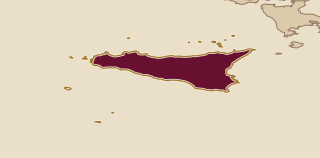
Mount Etna rises on the eastern edge of Sicily, and its north slope, facing toward the Alcantara valley and the Strait of Messina, carries a different light and cooler air than the sunnier southern and eastern flanks. Castiglione di Sicilia is the commune that covers much of this territory; the Sollicchiata area within it sits high enough that harvest runs from late September through late October, weeks behind most of lowland Sicily.
The Etna DOC appellation uses contrada names, the old Sicilian district markers, as a way of pointing to origin within the volcano. Pettinociarelle and Pignatuni, the two contradi where Famiglia Statella farms, each appear on the label of a separate Rosso cuvée, so the wine name doubles as a map reference. Buying one bottle tells you where on the mountain the grapes grew.
In the cellar
Vineyards and cellar
Organic certification governs the vineyard work across both contradi. The aisles between rows are left untilled, which holds soil moisture, supports microbial life, and keeps the vine roots searching downward into volcanic material rather than feeding from surface cultivation. Natural fertiliser replaces synthetic inputs. Harvest runs late, from the end of September into late October, a direct consequence of altitude and north-facing aspect.
Calogero is the sole winemaker. Verified cellar details beyond organic farming are limited in available sources, so no fermentation vessel, ageing duration, or skin-contact period is asserted here.
Wines to know
The range in view
The range runs to four wines under the Etna DOC.
The Etna Bianco is made from Carricante, a white grape associated with Etna's eastern slopes though grown here on the north face. The producer describes a golden, straw-like colour; aromas of white peach, apricot, citrus and white flowers; firm acidity and a strong mineral character that the volcanic soil drives through the wine.
A useful way in
A bottle to begin with
Start with the Pignatuni Old Vines Etna Rosso. It is a single-contrada Nerello Mascalese from an old-vine parcel on the north slope, certified organic, and the most independently documented wine in the range. The Decanter review of the 2021 vintage confirms a level of press attention the estate's small production rarely attracts. In the glass it is spicy and balsamic, with firm grip and a finish that stays. It is not a gentle introduction: it is a wine that shows what Etna Nerello can do when the vines are old, the farming is careful, and the parcel has a character worth naming on the label.