
Why it matters
The producer
Fasoli Gino is a four-generation family estate in the Illasi Valley of eastern Verona. The winery makes wines across five appellations, from sparkling Prosecco to Valpolicella and Bardolino reds, to a serious barrel-aged Garganega white called Pieve Vecchia. What separates it from dozens of comparable Veneto estates is timing: the family converted to organic farming in 1984, when organic viticulture in northeastern Italy was not a positioning decision but a genuine outlier. Natalino Fasoli runs the estate today as the third generation, with his son Matteo representing the fourth.
The name Fasoli Gino honours the man who expanded the business in the 1970s. That expansion came with the chemical vineyard treatments standard in the era. Then Gino developed an allergy to those chemicals, and the direction changed.
Place and vineyards
Where the wines begin
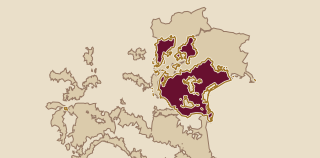
The Illasi Valley runs west to east through the hills of eastern Verona, opening onto the Po Plain. It sits outside the core sub-zones of the Valpolicella Classico area to the northwest, and well east of Lake Garda, where Bardolino has its natural home. Colognola ai Colli, where the winery stands at Via Cesare Battisti 47, falls within the broader Valpolicella DOC zone, which allows wines from the extended eastern hills as well as the classic western parishes.
Producing across multiple appellations from a single Illasi Valley base means the estate's range does not belong to one canonical wine address. The Valpolicella and Bardolino are DOC wines governed by their respective consortiums. The Prosecco is DOC, produced from Glera by the Charmat tank method. Pieve Vecchia sits outside any named village appellation and carries the broader Bianco Veronese IGT designation, which gives the winemaker latitude on grape variety, fermentation vessel, and ageing time that a strict DOC would not allow.
In the cellar
Vineyards and cellar
Fasoli Gino farms without pesticides, herbicides, or synthetic fertilizers. Regenerative practices and active biodiversity management are part of the daily vineyard routine, aimed at keeping the soil alive and the vine's immune system functioning without chemical support. Biodynamic preparations are applied, and lunar timing guides key vineyard operations.
In the cellar, method follows grape and wine ambition. The La Corte del Pozzo Valpolicella is fermented and matured entirely in stainless steel, which preserves the primary fruit character of Corvina, Corvinone, and Rondinella rather than adding oak or weight. A portion of those grapes undergoes light appassimento, drying on racks for 15 to 20 days before fermentation. This partial drying concentrates sugars and colour slightly and adds body and mid-palate density, but it stays well short of the extended drying used for Amarone or Ripasso.
Wines to know
The range in view
The main range is called La Corte del Pozzo and runs to ten wines. The Valpolicella DOC is the red anchor of the range: Corvina, Corvinone, and Rondinella, partially dried before fermentation, then raised in stainless steel. It opens with ripe cherry and spice on the nose and finishes dry, with a mid-palate weight that goes beyond a simple everyday red.
La Corte del Pozzo Prosecco Spumante DOC is made from Glera by the Charmat tank method, as Prosecco regulations require. It is fresh and light, with stone fruit and white flower, and carries 12.5% alcohol. The Bardolino DOC and Chiaretto di Bardolino DOC complete the light-red and rosato positions in the range.
A useful way in
A bottle to begin with
Start with Pieve Vecchia Bianco Veronese IGT. It is 100% Garganega, fermented in tonneaux and aged on lees for more than twelve months, with up to 15 years of declared ageing potential. The nose offers white peach, almond, and a light waxiness; the palate is textured rather than heavy, with firm acidity, a creamy mid-palate built by the lees, and a finish with a clean mineral spine. It is the wine that shows what the family's farming and cellar decisions actually produce when given time and space: Garganega from organic and biodynamic vines, handled in oak without being overwhelmed by it, aged long enough to develop real complexity.