
Why it matters
The producer
Bertrand Habsiger is not from Tuscany. He grew up in Alsace, trained as a sommelier, and later qualified as an oenologist before a friend gave him an unusual commission: go to Italy and make the most natural wine possible. Habsiger chose nine hectares in the Arezzo hills, surrounded by forest, on soils of clay over decomposed gneiss. The estate is called Fattoria di Caspri, and it also runs seven hectares of olives on the same land.
His Alsatian background shaped the range in a direct way. Sangiovese, Canaiolo, Trebbiano, and Malvasia grow alongside Pinot Noir, Syrah, and Grenache. The French varieties are not a commercial gesture; they are what a French-trained palate planted when it arrived in rural Tuscany with a mandate to farm without compromise.
Place and vineyards
Where the wines begin
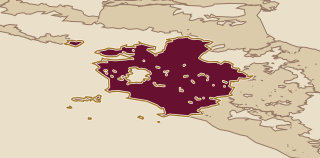
Arezzo sits in eastern Tuscany, roughly equidistant between Florence and Rome, away from the coastal Maremma and the Chianti Classico heartland. The land here is rural and relatively isolated. At Caspri, surrounding forest acts as a natural buffer: it reduces pest pressure, softens the microclimate, and provides the kind of biodiversity a biodynamic system depends on.
The hills around Arezzo are not a named wine appellation in the way Montalcino or Montepulciano are, which means the wines carry broader Tuscan designation rather than a village or zone label. For Habsiger, that is less a constraint than a condition of the project: the farming logic, not a classified address, is what the wines are built around.
In the cellar
Vineyards and cellar
The nine hectares are farmed without synthetic inputs. Tisane treatments use hot water infused with herbs to coat the vine and build its resistance; decoctions extract plant matter in cold water for a more concentrated preparation. Both replace copper and sulfur-heavy conventional spray programmes, though they require more frequent application and closer attention to weather.
No-till farming to ten centimetres means the topsoil compacts less, earthworm populations remain stable, and the vine roots develop without mechanical disruption. In a clay-heavy soil, regular deep ploughing in clay can harden lower layers and restrict drainage.
Wines to know
The range in view
The Fattoria di Caspri Rosso blends ninety-five percent Sangiovese with five percent Canaiolo. The Canaiolo softens Sangiovese's naturally firm tannin and adds a lighter, cherry-fruit lift to the blend. This is the wine listed by the Swedish retail monopoly Systembolaget, suggesting at least some export presence in Scandinavia.
The Rosso di Caspri is one hundred percent Sangiovese. The two wines diverge in method as much as in composition: the Rosso di Caspri uses eighty percent whole clusters through a full month of maceration in large conical wooden tanks, which pulls more tannin and aromatic complexity from the grape than a conventional destemmed fermentation. Both wines follow the same ageing parameters across the range: ten to twenty-two months, no fining, no filtration, no added sulfur.
A useful way in
A bottle to begin with
Start with the Rosso di Caspri. It is one hundred percent Sangiovese, farmed biodynamically, fermented with eighty percent whole clusters over one month in large conical wooden tanks, aged ten to twenty-two months, and bottled without fining, filtration, or added sulfur. Dark cherry on the nose, firm and savoury in the mouth, bright acidic finish with a tannic grip that signals how the wine ages. It is not a polished, ready-on-release bottle. It rewards patience and opens over two to three hours in a carafe. No other wine in the range makes the farming and the cellar philosophy as legible as this one does.