
Why it matters
The producer
Antonella Manuli spent ten years working in sustainability at Terme di Saturnia, a thermal resort complex in the southern Maremma. She fell in love with the landscape during that time, and in the mid-2000s conceived an agricultural project rooted in what she had learned there: that a farm could be run as an integrated system rather than a wine operation with a field attached. The estate she built, Fattoria La Maliosa, sits across two separate territories in Grosseto province. The Saturnia holding covers a 170-hectare landscape of vineyards, olive groves, arable land and forest on predominantly clay soils. The Pitigliano holding, roughly twenty kilometres southeast, adds three hectares of vines on volcanic ash and tuff.
Total vineyard area is 9.5 hectares. Oenologist Filippo Paoletti handles cellar work. The estate has been certified organic since 2010 and added SQNPI sustainable-quality certification in 2022.
Place and vineyards
Where the wines begin
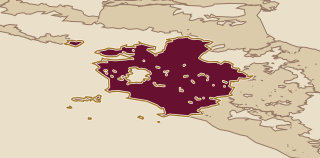
The southern Maremma is the least-visited part of Tuscany's wine map. Where the Chianti Classico zone and Bolgheri command most of the region's attention, the country around Saturnia and Pitigliano sits further south, closer to the Tyrrhenian coast and the border with Lazio. The landscape is wide and largely unirrigated, with thermal springs, tufa towns and a history of mixed farming rather than single-crop viticulture.
That mixed-farming past shapes La Maliosa directly. Ciliegiolo and Procanico are both local Tuscan varieties, not international grapes planted for market reasons. The IGT Toscana designation on the bottles reflects the estate's decision to work outside the Morellino di Scansano DOC zone, giving Manuli the freedom to use the varieties she recovered from the old vineyard without appellation-mandated grape percentages.
In the cellar
Vineyards and cellar
The 9.5 hectares carry five principal varieties: Ciliegiolo and Sangiovese as the lead reds, grey Cannonau for a third red direction, Procanico and Ansonica in white. That variety selection reflects what Vigna Madre contained, not a planting decision made from current market preferences.
In the cellar, grapes are hand-harvested and fermented spontaneously with the yeasts carried in from the vineyard. Maceration runs for three to four weeks, which for a grape like Ciliegiolo means extracting colour and fruit over an extended window without pressing for additional tannin. Wines mature in wood for five to sixteen months. No additives enter the cellar at any stage, and no sulfites are added. The approach produces wines that retain a living quality after bottling, particularly visible in the Uni, which the producer describes as a wine that continues to change in the glass and over time.
Wines to know
The range in view
La Maliosa Rosso is a varietal Ciliegiolo, labelled IGT Toscana. Ciliegiolo is a Tuscan red grape with a cherry-forward aromatic profile, lower tannin weight than Sangiovese and a natural freshness. The nose carries wild morello cherry, dried rose and Mediterranean scrub. On the palate, the tannins are soft, the acidity is vivid, and the finish is long. This is the estate's most documented and most accessible red.
La Maliosa Uni is an orange wine made from Procanico, a local Tuscan name for Trebbiano Toscano, grown on the Pitigliano volcanic parcels. Extended skin contact gives the wine its colour and a tannic grip that white Procanico would not have. Persistent floral and citrus aromas, bitter almond on the finish, a mineral thread running through the mid-palate. The producer is direct that the Uni changes after bottling and continues to develop in the glass.
A useful way in
A bottle to begin with
La Maliosa Rosso is the first bottle. It is varietal Ciliegiolo, IGT Toscana, made without additives or added sulfites, fermented spontaneously and matured in wood after a three-to-four-week maceration. The nose is specific: wild morello cherry, dried rose, a scrubby herbal note that comes from Mediterranean macchia on the estate. The tannins are soft enough to drink without food pairing anxiety, the acidity is bright and present, and the finish is longer than the weight of the wine suggests it should be. It is the clearest single expression of what Manuli built: a Tuscan red from a local grape, farmed without chemistry, made without additives, and bottled with the character of its particular place.