
Why it matters
The producer
In 1990, three brothers from the province of Pescara founded a wine estate on the hills above Spoltore and spent the next four years deciding what it should become. By 1994, when Sabatino, Roberto and Andrea Di Properzio launched their formal development programme, the answer was already taking shape: Montepulciano d'Abruzzo at the centre, indigenous varieties only, and no international grapes regardless of what the market preferred.
That was a real choice. Through the 1990s, parts of Abruzzo were planting Cabernet Sauvignon and Merlot alongside local grapes, chasing export-friendly labels. La Valentina went the other way. The estate farms Montepulciano, Trebbiano Abruzzese and Pecorino, propagates all new vines from selections made within its own parcels, and has farmed organically under ICEA certification across all its vineyards since 2016.
Place and vineyards
Where the wines begin
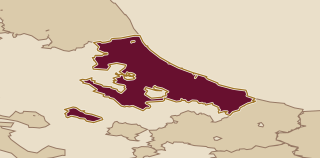
Spoltore is a hill town a few kilometres inland from Pescara, where the Adriatic plain meets the first Apennine foothills. Abruzzo runs east from the mountain spine to the sea, and the province of Pescara sits squarely in the middle of that transition. The altitude and the movement of air off the Adriatic give the vineyards around Spoltore a diurnal temperature range that slows ripening and preserves acidity in the grapes.
Abruzzo's DOC framework is organised around three appellations that correspond directly to grape and colour: Montepulciano d'Abruzzo for the red, Cerasuolo d'Abruzzo for the cherry-pink rosato made from the same grape, and Trebbiano d'Abruzzo for the white, which uses indigenous Trebbiano Abruzzese rather than the unrelated Trebbiano Toscano planted widely in central Italy. La Valentina's classic range runs one wine through each appellation. The terroir range stays entirely within Montepulciano d'Abruzzo, reading the same appellation at three levels of depth.
In the cellar
Vineyards and cellar
The vineyards are farmed without herbicides or desiccants, certified by ICEA, and managed to reach phenolic maturity before hand harvest. All new planting uses vines propagated from the estate's own vineyard selections, maintaining what the estate describes as its genetic continuity across replanting cycles.
In the cellar, the classic Montepulciano d'Abruzzo is fermented in stainless steel with a short maceration, producing a lighter-bodied red built for early drinking. The terroir wines move into wood. Spelt Riserva spends 16 months in mixed oak vessels, then transfers to 25-hectolitre oak casks for a further period, before one year in bottle ahead of release. That regimen adds grip and weight without overwhelming the grape's dark fruit. Cellar protocols for Docheio and Bellovedere individually have not been established from available sources.
Wines to know
The range in view
La Valentina runs two parallel ranges. The Linea Classica covers the three main Abruzzese appellations: Montepulciano d'Abruzzo DOC in red, fermented in stainless steel with short maceration, giving dark cherry and plum with approachable tannin; Cerasuolo d'Abruzzo DOC, the cherry-pink rosato made from Montepulciano grapes, carrying the appellation's characteristic colour and fresh red-fruit weight; and Trebbiano d'Abruzzo DOC, white from indigenous Trebbiano Abruzzese, a grape distinct from the more neutral Trebbiano Toscano found elsewhere in central Italy.
The Linea Terroir takes Montepulciano d'Abruzzo deeper at three named sites. Docheio and Bellovedere are both single-vineyard DOC expressions, each from a named parcel, with extended wood élevage separating them from the classic bottling. Spelt Montepulciano d'Abruzzo DOC Riserva is the top wine: darker, denser, and more tannic than the entry red, with the oak regime adding layers of grip and spice over the grape's core dark cherry and tar. The 2018 Spelt showed dark fruit and firm tannins in Falstaff's assessment. All three terroir wines are 100% Montepulciano d'Abruzzo.
A useful way in
A bottle to begin with
Spelt Montepulciano d'Abruzzo DOC Riserva is where La Valentina's choices land in a single bottle. It is 100% Montepulciano from a named parcel on the Spoltore hills, aged 16 months in mixed oak vessels, finished in 25-hectolitre casks, and held a further year in bottle before release. In the glass it gives dark cherry, dried plum and tar on the nose, a dense mid-palate with firm tannin, and a long finish where oak spice and the grape's natural acidity work together rather than against each other. No residual sweetness, no international grape varieties, no oak character that competes with the fruit.