
Why it matters
The producer
Selvapiana sits at the foot of the Apennines in the Rufina valley, roughly 25 kilometres northeast of Florence. It has belonged to one family since 1827, when Michele Giuntini, a Florentine banker, acquired what had been a medieval defensive watchtower and gradually expanded it into a working estate. The property now stretches across 250 hectares in three municipalities: Rufina, Pontassieve, and Pelago, with about 58 hectares planted to vines and another 140 under woodland.
Francesco Giuntini ran the estate from 1957 to 1997. His tenure included the 1979 Bucerchiale debut and a succession arrangement that placed the estate in the hands of Federico and Silvia Giuntini Masseti, his adopted children. Federico and Silvia are the son and daughter of Franco Masseti, who served as estate manager from 1953 to 1990, giving the handover a quality of earned continuity rather than formal inheritance. Federico now handles the vineyards and winemaking; Silvia oversees the office.
Place and vineyards
Where the wines begin
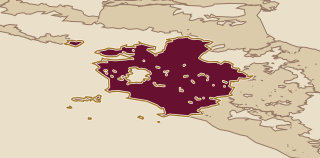
Chianti Rufina is a small sub-zone of the Chianti appellation: geographically distinct, climatically cooler, and consistently overshadowed in the market by Chianti Classico to the south. The distinction is real and matters in the glass. Rufina sits higher, in a valley cut by the Sieve river and backed by the Apennines. The mountains give the vineyards longer days in summer, colder nights, and a growing season that extends later into autumn than in the warmer Classico zone. That extra hang time builds concentration in the Sangiovese without sacrificing the acidity that defines the grape's character in cool conditions.
On the label, Chianti Rufina qualifies as its own DOCG, separate from Chianti Classico. Wines labelled Riserva must meet additional ageing requirements. Selvapiana's single-vineyard designation, Vigneto Bucerchiale, sits within that Riserva category and names the specific parcel on the bottle.
In the cellar
Vineyards and cellar
Organic farming at Selvapiana covers both the vineyards and the olive groves. Federico began converting selected parcels in the summer of 1987 and extended the method across the whole estate once the first plots showed the approach was sound. Certified organic status now applies to all vine and olive cultivation.
In the cellar, Bucerchiale follows a traditional Rufina line. The 2022 vintage was aged for 15 months in medium-sized oak casks and French oak barriques, with 10 per cent new wood. That proportion of new oak is deliberately low: it rounds the tannin without imposing vanilla or toast character, leaving the fruit and acidity of Sangiovese to do the work. The wine is not filtered or treated to accelerate softening. What goes into the bottle reflects what the parcel produced that year.
Wines to know
The range in view
The range follows the Chianti Rufina hierarchy from the ground up. Entry-level Chianti Rufina is a Sangiovese-dominant blend made for earlier drinking: lighter extraction, shorter oak contact, and fruit that is accessible in the first two to four years. It carries the appetising cherry and herb character typical of cool-grown Sangiovese, with enough acidity to work well at the table.
The Riserva tier raises the oak ageing and selection standard. The wine comes from older parcels, spends longer in wood, and builds more tannic depth. It has the acid backbone to develop over a decade.
A useful way in
A bottle to begin with
Chianti Rufina Riserva Vigneto Bucerchiale is the bottle to begin with. It is a single-parcel Sangiovese Riserva aged in medium-sized casks with restrained new oak, and it carries the two things that make Rufina worth understanding: the concentrated dark fruit that comes from Apennine-foot vines with genuine age, and the bright, mouthwatering acidity that keeps the wine from ever feeling heavy. The tannin is firm and requires two to three years of bottle age from release, but once it settles, the dark cherry, graphite, and tobacco character integrates into a long, dry, savoury finish. It is not a polished or easy-drinking wine.