
Why it matters
The producer
Femar Vini is registered in Monte Porzio Catone, a hill town in the Castelli Romani area southeast of Rome, but its wines come from further south. Felice Mergè founded the company in 1995 by converting his father Armando's earlier regional business into a new operation with a wider sourcing map: Primitivo, Negroamaro, and Fiano from Puglia, Nero d'Avola from Sicily, Montepulciano from Abruzzo. The company owns around 40 hectares of vineyards and draws additional supply from associated producers.
The name is a compressed family document. FE comes from Felice, MAR from Armando Mergè. The company, in its title, carries two generations. A third generation back, Manlio Mergè had produced wine and olive oil in the 1920s, though Manlio's methods and location were different from what Felice built.
Place and vineyards
Where the wines begin
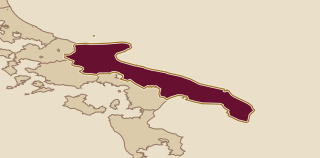
The Puglia that supplies most of Femar's labelled wines is Italy's southern heel: flat to gently rolling limestone plains and low hillsides running toward the Adriatic and Ionian coasts. The climate is hot, dry, and intensely sunny through summer, which pushes grapes toward ripe, full-bodied, deeply coloured reds. Primitivo ripens early in this heat, developing dark fruit concentration and high natural alcohol. Negroamaro, grown in the Salento peninsula at Puglia's southern tip, adds darker, more tannic weight to the mix.
Femar's registered address is in the Castelli Romani hills, a different place entirely: the volcanic landscape of extinct craters south of Rome, associated with Frascati and other white wines. The grapes and wine personality on Femar's bottles are Puglian, not Roman. Fiano, Primitivo, and Negroamaro carry the heat, weight, and southern Italian character of the region they actually come from.
In the cellar
Vineyards and cellar
Femar's 40 hectares of owned vineyards are spread across its sourcing regions, supplemented by fruit and wine from associated companies. The cellar in Monte Porzio Catone covers approximately 6,000 square metres and runs two distinct winemaking systems side by side.
One side is built for fresh, clean wine styles: cold technology, stainless-steel fermentation tanks and storage vessels, a modern bottling line, and a laboratory for ongoing analysis. Temperature control through stainless steel keeps fruit character bright and primary, which suits the aromatic profile of wines like Fiano and lighter expressions of Primitivo.
Wines to know
The range in view
Femar's portfolio spans nine brands: Masseria Trajone, Faunus, Nero Grande, Antico Ceppo, Montecore, Anfiteatro Tuscolano, Urbe Aeterna, Terre Domiziane, and Epicuro. Epicuro carries the widest distribution and the most commercially visible range.
Epicuro Zinfandel is made from Primitivo grown in Puglia. Production rules set a minimum of 85% Primitivo, with other permitted grapes filling the balance; the 2024 vintage was bottled at 100% Primitivo. The wine is deep red in colour, with dark plum and blackberry fruit on the nose, a spicy, peppery quality on the palate, and a full, warm body that reflects Puglia's ripening conditions. It drinks accessibly young but carries enough dark-fruit depth to hold for a few years.
A useful way in
A bottle to begin with
Start with Epicuro Zinfandel (Primitivo) from Puglia. It is the plainest expression of what Femar does with its most important grape: ripe Primitivo from southern Italian sun, fermented clean, bottled accessible. The wine is dark, warm, and generous in the glass, with dark fruit and pepper across the palate and a full body that reflects the grape and the climate together. It carries no oak character and no added complexity. Drink it within three to five years of vintage, with grilled lamb or a plate of cured meats, and the combination of southern grape, heat, and accessible weight becomes immediately legible.