
Why it matters
The producer
Fratelli Cigliuti farms the Serraboella hill in Neive, a commune in the Barbaresco DOCG zone of Piedmont. The family had sold grapes and bulk wine for generations before Renato Cigliuti changed course in 1964, bottling the harvest under the Cigliuti name for the first time. That first release was 300 bottles of Barbaresco. Six decades later, the estate is still defined by the same vineyard, the same grape, and the same argument that Renato made when his neighbours thought he was wasting fruit: you cannot have quality and quantity on the same vine.
Renato's daughters Claudia and Silvia now run the estate. The range has not expanded far from its origin. Serraboella gives its name to both the Barbaresco and the Barbera d'Alba, and the hill is the through-line in label, farming philosophy, and glass character alike.
Place and vineyards
Where the wines begin
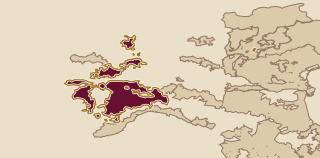
Neive is one of the four main communes in the Barbaresco DOCG zone, alongside Barbaresco, Treiso, and San Rocco Seno d'Elvio. The zone sits in the Langhe hills of Piedmont, with Nebbiolo as the only permitted grape for Barbaresco. Standard Barbaresco requires a minimum of 26 months ageing before release, at least 9 of those in oak, a timeline that shapes how the estate plans its cellar and when its wines reach the market.
Serraboella is the hill that organises the estate. It sits within the Neive commune and gives the estate its primary address across both its Nebbiolo and Barbera wines. The mineral and saline character noted in the Barbaresco Serraboella tasting record is consistent with what this particular slope produces, though the estate does not make detailed soil composition claims and neither do the wines need them.
In the cellar
Vineyards and cellar
Green harvesting is the founding vineyard practice here, introduced by Renato before it had broad acceptance in the Langhe. Thinning the crop reduces the number of grape clusters the vine carries to maturity, concentrating sugars, colour compounds, and aromatic intensity in what remains. In the glass, the effect is visible: the Barbaresco Serraboella has compact, ripe tannins and concentrated fruit rather than the dilute character that comes from overcropped Nebbiolo.
For the Barbaresco, oak ageing is part of the cellar work, in line with DOCG requirements and the estate's own preference for wines with the depth to develop over many years. The precise split between oak vessel types and ageing duration for current vintages is not confirmed in published sources; the approach is calibrated toward long-term drinking, not early release. The 2021 Barbaresco Serraboella is estimated to drink well through 2042.
Wines to know
The range in view
The range is built around Serraboella and two grapes.
Barbaresco Serraboella is Nebbiolo from the estate's home parcel in Neive, aged in oak before release. It is the wine that carries the most time in the cellar and the most age expectation at release. The 2021 has a jewelled ruby colour, ripe and compact tannins, and a mineral feel with even acidity across the palate. It is not a wine to open young.
A useful way in
A bottle to begin with
Begin with the Barbaresco Serraboella. It is a single-vineyard Nebbiolo from the estate's home parcel in Neive, and it carries everything the estate has built since 1964: low-yield farming, unhurried oak ageing, a mineral, saline finish from the Serraboella hill, and ripe, compact tannins that need time to settle. Cedar, leather and raspberry open it; licorice and mocha come later. The acidity is even and sustained. Open it at least two to three years after the vintage date. It will still be improving a decade after that.