
Why it matters
The producer
Fratelli Martini Secondo Luigi built a sparkling wine export operation from a farmhouse in Cossano Belbo, on the Piedmont side of the hills bordering Veneto. Secondo Martini founded the company in 1947 and put the first winery immediately below his own home, next to what is now the company headquarters. That detail still describes the character of the house: family-run, incrementally built, and structured around continuity rather than reinvention.
Three generations have worked the same logic at larger scale. The second generation drove international expansion through the 1970s and 1980s, establishing the export channels that now reach more than 60 countries. Eleonora Martini joined in 2011 from a career in Milan's fashion industry, bringing brand management discipline to a business whose volume and reach had grown well ahead of its public profile. The Casa Sant'Orsola label is the commercial face of that output: Prosecco DOC made from Glera and other authorized Veneto varieties, positioned for accessible, everyday drinking.
Place and vineyards
Where the wines begin
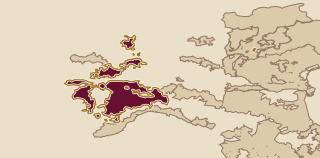
Prosecco DOC draws its Glera from Veneto, the broad appellation covering the foothills and plains northeast of Venice. The DOC designation allows fruit from across a wide geographic area, which is why Prosecco at this commercial scale differs from the tighter Prosecco Superiore DOCG produced in the hillside zones around Conegliano and Valdobbiadene. The DOC label on a Casa Sant'Orsola bottle means Veneto-grown Glera, Charmat-method production, and a wine calibrated for approachability: low alcohol, soft mousse, and fruit-forward aromatics without the mineral depth of a hillside single-vineyard expression.
Cossano Belbo itself sits in Piedmont's Langhe and Monferrato hills, wine country better known for Moscato d'Asti and Barbera than for sparkling wine. Fratelli Martini's operation spans both regions in practice: the business roots are Piedmontese, the Prosecco raw material is Venetian.
In the cellar
Vineyards and cellar
Casa Sant'Orsola Prosecco is made using the Charmat method, also called the Martinotti method after its Italian developer. In this process, the base wine undergoes its second fermentation inside a pressurized tank, which traps carbon dioxide and creates the bubbles. The tank environment preserves the fresh, fruity aromatics of Glera: peach, apricot, and citrus stay vivid because the wine spends weeks rather than years in contact with yeast. This produces a light, mousse-forward sparkling wine rather than a complex, aged one.
For the Prosecco Brut Millesimato 'LX', the house uses 100% Glera at 11% alcohol, which keeps the wine light in body and tilts the aromatic profile toward tropical fruit, citrus, and florals. The extra dry Millesimato carries a small residual sugar level, which rounds the palate and softens the acidity without making the wine sweet in any obvious sense.
Wines to know
The range in view
The Casa Sant'Orsola range runs across two Prosecco expressions and a botanical aperitivo.
The entry-level Casa Sant'Orsola Prosecco Millesimato is labeled extra dry, meaning a controlled residual sugar that sits between brut and demi-sec on the Prosecco sweetness scale. In the glass it is straw yellow with fine, persistent bubbles. The nose opens on peach, apricot, wisteria, and acacia. The palate is fruity and savory, with well-present, balanced acidity that keeps it from feeling soft or flat.
A useful way in
A bottle to begin with
Start with the Prosecco Brut Millesimato 'LX'. It is 100% Glera from Veneto, made by the Charmat method at 11% alcohol, and it shows the cleaner edge of what this house does with its core grape. The brut dosage keeps the wine drier than the entry Millesimato, which lets the tropical fruit, citrus, and floral aromatics carry without the rounding effect of extra residual sugar. The palate is soft and creamy with a fresh finish. It is light enough to drink before eating and structured enough to hold up alongside food. At this price point and volume level, that balance is the skill.