
Why it matters
The producer
Most Napa Valley estates grow Cabernet Sauvignon on irrigated vines and age the wine in new French oak. Frog's Leap does neither. John Williams founded the estate in 1981, certified it organic in 1989 before organic farming was commercially fashionable, and built a portfolio that splits evenly between white and red wines at a time when most of the valley had decided Cabernet was the only answer.
The estate sits at the Red Barn ranch in Rutherford, a property with roots going back to the Adamson Winery of 1884. Williams studied fermentation science at Cornell and moved to California in 1974, working first at Taylor Wine Company and then at Stag's Leap Wine Cellars before co-founding Frog's Leap with Larry Turley in 1981. Their first vintage was 700 cases of Sauvignon Blanc, sourced from Spottswoode. The grape was a statement of intent. It remains the estate's founding wine more than four decades later.
Place and vineyards
Where the wines begin
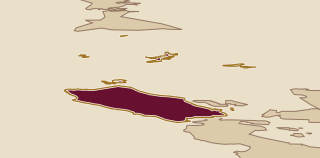
Rutherford is a Napa Valley appellation on the valley floor between Oakville to the south and St. Helena to the north. The soils are deep alluvial loams, and the Cabernet grown here develops a character that growers and critics have called Rutherford Dust: a dry, earthy, almost loamy quality on the mid-palate that softens tannin and gives the wine a characteristic gravity without weight. It is a texture more than a flavour, and it is readable in Frog's Leap Cabernet alongside the black fruit and dried herb aromatics.
The appellation label on a bottle of Frog's Leap Cabernet Sauvignon signals that grape, place and the Rutherford floor are doing most of the work, not new oak or concentrated extraction.
In the cellar
Vineyards and cellar
Dry farming is the first cellar decision, made before harvest. Vines without irrigation produce smaller berries and more concentrated juice, but the cellar philosophy then pulls in the opposite direction from concentration: moderate extraction, neutral vessels, long lees contact rather than new-oak richness.
The Sauvignon Blanc receives skin contact before a slow, cool fermentation, then seven months on lees in stainless steel and concrete with no new oak and no malolactic fermentation. That sequence preserves aromatic lift and acidity rather than building body.
Wines to know
The range in view
Frog's Leap makes four core wines. Two are white, two are red, and the split is deliberate.
The Sauvignon Blanc is the founding wine. Estate and grower dry-farmed organic fruit, no malolactic fermentation, no new oak, seven months on lees: the profile runs from Meyer lemon and grapefruit through lime zest, green pear, and wet stone, with a mineral thread across the finish. The acidity is sharp and clean.
A useful way in
A bottle to begin with
The Sauvignon Blanc is the right first bottle. It was the first wine Frog's Leap made in 1981 and it still carries the estate's central argument: that dry-farmed organic farming and a cellar that avoids extraction produce something more interesting than the Napa Cabernet default. Skin contact, slow cool fermentation, seven months on lees, no new oak, no malolactic fermentation: every decision points toward preserving fruit character and acid line rather than building body. What arrives in the glass is lean, aromatic, and precise, with Meyer lemon, grapefruit, lime zest, and a mineral finish that stays with you. It costs significantly less than the Cabernet and says more about what the estate actually believes.