
Why it matters
The producer
Rosé, red and fortified wines carry Gérard Bertrand's name across several Languedoc appellations. Gris Blanc, Clos du Temple and Côte des Roses are rosés. Heritage An 806 Corbières, Château L'Hospitalet La Réserve Rouge, Gérard Bertrand Corbières and Cigalus Rouge are reds. Rivesaltes Ambré and Legend Vintage Maury are fortified wines.
The range moves between Pays d'Oc, Languedoc, La Clape and Corbières labels, with Rivesaltes and Maury on the fortified bottles. Gérard Bertrand's blending work is shared with his team and passed on to his wife Ingrid and their children, Emma and Mathias.
Place and vineyards
Where the wines begin
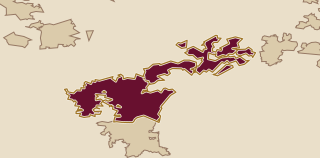
The Languedoc name appears across several appellation labels, with each bottle carrying its own geographic category. Gris Blanc is labeled Pays d'Oc, while Clos du Temple and Côte des Roses carry Languedoc. Château L'Hospitalet La Réserve Rouge carries La Clape, and Gérard Bertrand Corbières and Heritage An 806 Corbières carry Corbières.
Rivesaltes Ambré and Legend Vintage Maury carry the names of fortified wine appellations. The labels therefore move from Pays d'Oc and Languedoc rosé to La Clape and Corbières reds, then to Rivesaltes and Maury fortified wines.
In the cellar
Vineyards and cellar
The documented cellar methods change by bottle. Gris Blanc is hand harvested and directly pressed under CO₂ protection to preserve delicate aromas. It remains on fine lees for several weeks before bottling. Fine lees are the yeast cells left after fermentation, and time on them can add a rounder texture while keeping the wine fresh.
Clos du Temple is harvested by hand in crates at sunrise. The must is clarified at controlled temperatures of 8 to 10°C for 24 hours without added sulfites, then matured in new barrels for six months on fine lees with yeast stirring. Stirring keeps the lees in contact with the wine and can build texture.
Wines to know
The range in view
The rosé range includes Gris Blanc as a Pays d'Oc wine, Clos du Temple and Côte des Roses as Languedoc wines. Clos du Temple is a blend of Grenache, Cinsault, Syrah, Mourvèdre and Viognier.
The red range includes Heritage An 806 Corbières, a blend of Grenache, Syrah and Mourvèdre, alongside Château L'Hospitalet La Réserve Rouge from La Clape, Gérard Bertrand Corbières, Cigalus Rouge, Héritage Cabernet Sauvignon and Héritage Pinot Noir. The fortified wines are Rivesaltes Ambré and Legend Vintage Maury.