
Why it matters
The producer
Borgogno was founded in 1761 by Bartolomeo Borgogno in the Langhe hills of Piedmont. The estate has farmed Nebbiolo in the Barolo DOCG ever since, through the Kingdom of Savoy, Italian unification, two world wars, and a change of ownership in 2008. That continuity is not passive. The cellar method that Borgogno uses today, spontaneous fermentation in concrete tanks and long ageing in large Slavonian oak casks, is the same method that defined classical Barolo before the modernist wave of the 1980s and 1990s introduced temperature-controlled fermentation and small French barrique. Most estates that survived that period moved toward the new approach, at least partly. Borgogno did not.
In 2008, Oscar Farinetti, the entrepreneur who built Eataly into an international food retail institution, bought the 247-year-old winery. The acquisition was widely watched because Farinetti is a builder and marketer by instinct. He kept the Slavonian oak, the long maceration, and the indigenous yeasts. The house method did not change. For a buyer trying to understand what traditional Barolo actually is, Borgogno is a working example, not a historical curiosity.
Place and vineyards
Where the wines begin
Barolo is a DOCG appellation in the Langhe, the system of hills south of Alba in Piedmont. The grape is Nebbiolo, a variety that produces wines of high acidity and firm tannin, with an aromatic register of dried flowers, tar, red cherry, and balsamic lift. Those structural qualities make Barolo one of the longest-lived red wines in Italy. Young bottles are often austere. A decade of bottle age is not unusual before a serious Barolo reaches an approachable state.
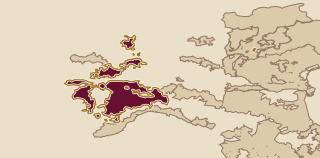
Borgogno farms 52 hectares across three vineyard zones. The Barolo zone in the Langhe holds the flagship parcels, including the 1.30-hectare Cannubi plot and additional holdings in Liste and Fossati. A further area around Madonna di Como near Alba produces Langhe-appellation fruit. The Colli Tortonesi holdings, to the northeast toward the Ligurian border, supply fruit for the estate's Cortese and Timorasso expressions.
In the cellar
Vineyards and cellar
Fermentation at Borgogno begins spontaneously, with indigenous yeasts from the vineyard and cellar rather than laboratory-selected cultures. For the Barolo Classico, this runs for approximately 15 days in concrete tanks at temperatures between 22 and 28 degrees Celsius, followed by 20 days of submerged cap maceration. The submerged cap technique keeps the grape solids in constant contact with the fermenting juice, which extracts colour, tannin, and aromatic compounds more evenly than punch-down or pump-over alone. That extended skin contact is one of the reasons Borgogno's wines carry such firm tannin on release.
The Cannubi fermentation runs slightly shorter, approximately 12 days with indigenous yeasts, starting at 22 to 25 degrees Celsius and rising to 29 to 30 at the end, then 40 to 50 days of submerged cap maceration. Longer maceration on this parcel deepens the tannic frame and the aromatic complexity.
Wines to know
The range in view
The Barolo range has three levels. The Classico is a multi-site blend from five vineyard parcels, 100% Nebbiolo, fermented spontaneously and aged for a minimum of 24 months. It arrives at ruby with garnet highlights, with fresh red fruit on the nose and spice in the background. The acidity is present and clean, and the tannin reads as integrated rather than raw on release, which makes it the most accessible point in the Borgogno range.
The Barolo Riserva draws from Cannubi, Liste, and Fossati. Six years in large Slavonian oak and six months in bottle before release is the longest ageing programme in the range. By release it carries deeper colour integration, a more dried-fruit aromatic register, and a firmer tannic frame than either the Classico or the Cannubi.
A useful way in
A bottle to begin with
Barolo Cannubi is the right first bottle. It comes from 1.30 hectares of calcareous clay marl on the Cannubi hill, fermented with indigenous yeasts for 12 days, macerated for 40 to 50 days, and aged for four years in 4,500-litre Slavonian casks. It is dry, high-acid, and tannic by nature. The nose carries raspberry, balsamic lift, and minerally depth; the palate is concentrated but aromatic, with a long tannic finish that has more fineness than aggression. It needs time. Five years from vintage is a reasonable minimum; ten is better.