
Why it matters
The producer
Giacomo Grimaldi is a small Barolo estate working three named vineyard parcels across three municipalities in the Langhe. The family's connection to the land in Barolo municipality goes back to 1930, when the great-great-grandfather purchased a farmstead and vineyards there. The current commercial label is a different chapter: Ferruccio Grimaldi launched it in 1996, gave the operation a new label, and chose to name the estate after his nephew Giacomo rather than himself. Ferruccio and his son Alberto now run the estate together, with four generations of family involvement in the land behind them.
The producer sits between Barolo's two dominant schools. The aging protocol for Nebbiolo uses both French barriques and large traditional cask, pulling from the modernist and traditionalist camps without committing fully to either.
Place and vineyards
Where the wines begin
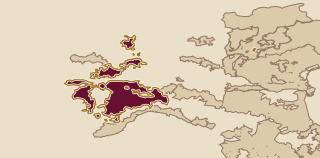
Barolo is a DOCG appellation in the Langhe hills of southern Piemonte, built entirely around Nebbiolo. The name on the label identifies both the wine and the appellation; within that appellation, named vineyard sources now carry real legal and commercial weight.
Giacomo Grimaldi draws from three municipalities within the Barolo DOCG, each with a different soil character and vine orientation. Le Coste sits in the Barolo municipality itself, at around 300 metres on limestone-clay soil threaded with sandy Sant'Agata fossil marl. Ravera is in Novello, facing south-east, with loam and clay modulated by fossil marl. Fornaci is in Monforte d'Alba, on a westward-facing slope. The contrasting aspects matter for Nebbiolo: south-east and west exposures ripen differently and deliver different tannin weight, so three crus from the same producer tell three versions of the same grape.
In the cellar
Vineyards and cellar
Le Coste, Ravera, and Fornaci are each harvested as separate parcels and vinified to the estate's standard Barolo protocol: 12 months in French barriques, with 25 percent new oak, followed by 12 months in large traditional cask, then 8 months in stainless steel, and 8 months in bottle before release. The sequence is deliberate. The barrique phase allows some oxygen integration and softens the raw tannin grain of young Nebbiolo; the large cask phase allows the wine to settle and the oak to recede; the steel and bottle rest adds composure before the wine leaves the cellar. The result sits between the pure-barrique modernist style, which seeks immediate approachability, and the pure-large-cask traditionalist approach, which demands patience.
The Nebbiolo d'Alba Valmaggiore follows a different path. Seven to eight days of controlled-temperature maceration in steel gives a shorter extraction than the Barolo crus, and malolactic fermentation happens in barrique, with half new oak, before mixed-vessel aging continues. This is a softer, earlier-drinking Nebbiolo from outside the DOCG zone.
Wines to know
The range in view
The core range is Barolo from three named crus and a Nebbiolo d'Alba from Valmaggiore fruit.
The Barolo crus share a grape and a protocol but come from different soils and aspects. Le Coste (Barolo municipality) is the oldest-vine parcel, at around one hectare, with 70-year-old vines on limestone-clay and Sant'Agata marl. The vine age and the marl contribute to wines with more fragrant, lifted character and tannins that, while firm, are not brutal. Ravera (Novello, half a hectare, south-east aspect) brings riper, more rounded fruit from its warmer exposure. Fornaci (Monforte d'Alba, half a hectare, westward slope) ripens more slowly and tends toward firmer, more mineral-driven Nebbiolo. All three carry the characteristic Barolo architecture: dark ruby colour, dried flowers, cherry and plum, tobacco and earth, with tannins that demand time.
A useful way in
A bottle to begin with
Start with the Barolo Le Coste. It is Nebbiolo from the estate's oldest vines, around 70 years old, on limestone-clay with Sant'Agata fossil marl in the Barolo municipality itself. The mixed-vessel aging gives the wine an accessible tannin grain without losing the firm Nebbiolo backbone: dried flowers, cherry, leather and mocha on the nose; a dense mid-palate; and a long earthy finish. It is the parcel with the deepest-rooted vines, the richest soil character, and the clearest line between what the place does and what the cellar adds. Let it breathe for an hour, or open it five years after vintage and find something more composed.