
Why it matters
The producer
Giovanni Almondo farms Arneis the way Burgundy farms Chardonnay: parcel by parcel, vinification by vinification, lees ageing by lees ageing. The estate sits in Montà d'Alba, the central village of Roero Arneis production on the left bank of the Tanaro, and it produces three distinct Roero Arneis DOCG bottlings from 12 hectares of estate-grown Arneis. Domenico Almondo shaped the estate's quality direction from 1980. His son Federico trained at Nicolas Potel in Burgundy before returning to Roero, and the Burgundian formation is audible in every cellar decision the estate makes: separate harvesting from named parcels, individual vinification per cuvée, and a top bottling capped at roughly 1,000 bottles per vintage.
Arneis is a white grape that Piemonte once nearly abandoned, and Roero is the appellation that kept it. Almondo is among the clearest cases for what Arneis can do when treated as a serious single-vineyard white rather than a blended regional commodity.
Place and vineyards
Where the wines begin
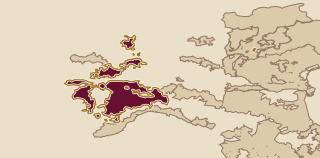
Roero sits across the Tanaro River from Langhe, the territory that produces Barolo and Barbaresco. Where Langhe rests on compact Tortonian marl and limestone, Roero sits on looser, sandier soils with a greater calcareous content, and the difference shows in its wines: lighter body, earlier aromatic expression, and a lifted mineral character rather than the tannic weight of the opposite bank.
Roero Arneis DOCG covers the white wines produced in this zone, and the appellation names the grape: Arneis, a white variety that must make up at least 95 percent of the blend. It is an aromatic grape, producing dry whites with stone fruit, herbs, and a savory mineral lift that the sandy calcareous soils of Montà d'Alba amplify.
In the cellar
Vineyards and cellar
Fourteen of the 15 hectares are estate-owned; one is leased. Arneis occupies 12 hectares; Nebbiolo covers 3. The family partnered with a research institution in Turin on an Arneis clonal selection project using heritage vines from across the Montà area.
In a normal vintage, the estate produces 80,000 to 90,000 bottles of Arneis, all from fruit grown on the estate.
Wines to know
The range in view
Three Arneis bottlings form the range, moving from the parcel-specific entry level to the small-production single-parcel top.
Bricco delle Ciliegie (Roero Arneis DOCG) comes from the estate's Bricco delle Ciliegie parcel. It is the most direct expression in the range: chalk and lemon on the nose, a core of ripe pear, dry on the palate, with the savory mineral finish that Roero's sandy soils produce.
A useful way in
A bottle to begin with
Start with Vigne Sparse. It is the mid-range bottling, widely distributed outside Italy, and it is kept on lees for as long as possible, showing the pale straw colour with its green tint, the layered nose of stone fruit, honey, herbs, and wet stones, and the distinctive savory finish with its oyster and salt notes. Le Rive del Bricco is worth seeking once the style is familiar; Vigne Sparse shows pear, apple, and acacia honey, with citrus and green hints on the nose.