
Why it matters
The producer
Giuseppe Russo was a concert pianist and literature doctoral graduate before he became a winemaker. When his father Girolamo died, Giuseppe returned to the family's volcanic parcels on the eastern slopes of Mount Etna and founded the estate in 2005, naming it for the man he had come back to honour. The wines he makes there carry none of the warm, heavy character most people expect from Sicily. They are lean, aromatic, and high in acidity, grown on black basalt at altitude where the mountain's elevation functions more like a northern Italian hillside than a southern island.
The estate works across several contrade, the named local districts on Etna that function like vineyard lieu-dits: distinct parcels with distinct names, vinified separately and bottled under their own labels. This is not a blending house. Each bottle traces to a single piece of ground.
Place and vineyards
Where the wines begin
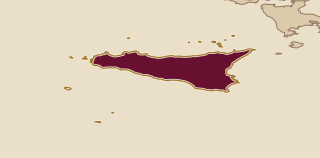
Mount Etna is an active volcano in eastern Sicily, and the wine growing happens on its slopes rather than on the flat Sicilian plains below. Elevation changes everything here. At 600 to 780 metres, temperatures drop sharply at night even in summer, extending the growing season and preserving acidity that would be lost lower down. The soils are volcanic basalt and ash, low in organic matter, well-drained, and hostile enough that vines must root deeply and produce small yields.
The Etna DOC appellation covers production on the volcano's slopes. Within it, the contrade system provides a finer address: named sub-zones with distinct exposures, elevations, and soil compositions. A wine labelled San Lorenzo or Feudo di Mezzo comes from a specific named parcel, not from a blended appellation floor. For Nerello Mascalese grown on volcanic ground, that distinction matters in the glass.
In the cellar
Vineyards and cellar
The vines are old and the yields are low. Parcels between 600 and 780 metres on Etna's north-east face produce Nerello Mascalese grapes that arrive with naturally high acidity and moderate colour, a combination of cool nights, volcanic soils, and vine age that no warmer or younger vineyard can replicate. In the cellar, the approach is minimal: separate vinifications for each contrada, gentle handling to avoid extracting coarse tannin from the grape's naturally firm skins, and methods that allow the aromatic character to carry across from vine to bottle.
The result in the glass is a red wine with more in common with Nebbiolo from Barolo's cooler communes or Pinot Noir from the Loire than with the full-bodied reds Sicily is conventionally associated with.
Wines to know
The range in view
The range is built around single-vineyard Etna Rosso from named contrade. San Lorenzo is the estate's best-known cru, sourced from the highest parcel at approximately 780 metres on the north-east slope. It opens on thyme and rosemary with red forest fruit underneath and a lift of balsamic that rises from the glass before the palate arrives. The broader sensory register across the single-vineyard crus includes blackberry, Morello cherry, currant, Mediterranean herbs, sandalwood, leather, and tobacco leaf, with the herbal and volcanic notes sharpening at higher elevations.
Piano delle Colombe is a micro-cuvée from a sub-section of the San Lorenzo parcel, released in approximately 750 bottles per year. The concentration is higher and the production smaller; it functions as an extreme expression of what the highest part of that parcel can deliver.