
Why it matters
The producer
Giulio Cocchi arrived in Asti from Florence in the 1880s as a pastry maker with no intention of staying. He married the daughter of a local bar owner, learned the Piedmontese aromatized wine trade, and built a house that would outlast him by more than a century. By 1913 he had opened seven Cocchi tasting bars across the region, expanding to twelve by the 1920s, an early franchise network built on botanical wines and the particular local appetite for bittersweet drinking.
The Bava family took ownership in 1978. Roberto Bava, who became chief executive at twenty, discontinued the vermouth line in the 1980s when the category died commercially, then relaunched it in 2010 on a single limited edition. The timing caught the first wave of the cocktail revival. The batch sold through. A full relaunch followed, and Cocchi became the house most associated with the post-2010 recovery of Vermouth di Torino as a serious category. Bava subsequently organised Italy's vermouth producers and secured Vermouth di Torino DOCG status, giving the category a protected designation it had never previously held.
Place and vineyards
Where the wines begin
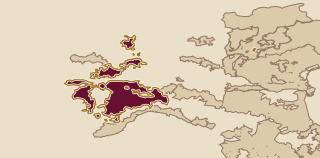
Asti sits in the southern half of Piedmont, in the Monferrato hills between Turin and the Langhe. The city has been the commercial centre of the Italian sparkling and aromatized wine trade since the nineteenth century: Moscato d'Asti originates from the surrounding hillside vineyards, and Barolo is made sixty kilometres southwest in the Langhe near Alba.
Cocchi is not a wine estate with its own vineyards. Its terroir relationship is carried through the base wines it sources: Barolo for the Chinato, Moscato d'Asti for the Vermouth di Torino. Both are Piedmontese DOCG wines with defined geographic origins. That sourcing logic connects the aromatized wines to the wine world rather than to the broader spirits trade: the base wine is not neutral grain spirit; it is wine with place, grape, and character before a single botanical is added.
In the cellar
Vineyards and cellar
Cocchi's production is botanical and blending work rather than vineyard or fermentation work. The Barolo Chinato begins with Barolo wine, adding cinchona bark (quinine), rhubarb, gentian, and a botanical blend developed within the house tradition. The quinine provides the primary bitter note; the Barolo base supplies tannin, depth, and a dry savour that carries the sweetness without collapsing into confection. The Storico Vermouth di Torino is built on Moscato d'Asti base, with cocoa and bitter orange as the dominant botanical additions, and no vanilla correction. That choice keeps the vermouth's bitter and aromatic character available for cocktail mixing, where a vanilla-forward vermouth softens and blurs against other ingredients. The Americano uses a fortified base wine with a bittersweet botanical composition designed for low-alcohol service, and its bitterness holds even in long dilution.
Wines to know
The range in view
Cocchi makes three aromatized wines, each with a different drinking position.
The Barolo Chinato is the prestige bottle. Built on Barolo wine and macerated with cinchona bark, rhubarb, gentian, and other botanicals, it is served neat in small glasses after dinner or over ice as a longer drink. The palate is bittersweet, with layered aromatic complexity and a perfume that opens gradually. The finish is long, with bitter herbs giving way to sweetness: liquorice, honey, and menthol emerge in sequence. Tannin from the Barolo base gives body and a dry frame that holds the sweetness in check.
A useful way in
A bottle to begin with
The Barolo Chinato uses Barolo wine as its base and includes cinchona bark, rhubarb, gentian, and other botanicals. It is Barolo wine, not a neutral spirit base, so it carries the Nebbiolo grape's tannin and depth through the entire production process. The botanicals work with that Barolo base rather than masking it. Served neat after dinner, a small pour at room temperature, it opens slowly: herb and bark on the nose, then a bitter mid-palate, then honey and menthol on a long finish. The sweetness and the bitterness are genuinely balanced across the whole glass, not split between a sweet entry and a dry finish.