
Why it matters
The producer
Giuseppe Mascarello e Figlio purchased its first cellars in Monforte d'Alba in 1881. The family had farmed Nebbiolo before that, as tenant managers on the Manescotto estate in La Morra, but 1881 is when they became landowners. The estate is now led by Mauro Mascarello, whose children Elena and Giuseppe work alongside him, and whose grandfather made decisions that still shape every bottle produced today.
The cellar position is a deliberate one. No French barriques. No deep-extraction, internationally styled Barolo. Mauro ages all his Nebbiolo in large Slavonian oak botti, some of them decades old, maintained and kept in use rather than replaced. The botti add nothing to the wine's colour or aromatic profile. They hold the wine and allow it to develop slowly, and what comes out carries the character of the grape and the vineyard rather than the wood.
Place and vineyards
Where the wines begin
The estate draws its main Barolo bottlings from two communes with markedly different soils and characters. Castiglione Falletto sits on a ridge between the Tanaro tributaries at 250 to 350 metres, on compact Tortonian marl soils locally called Lequio formation. These soils produce wines of finer extraction and more supple tannin. Monforte d'Alba, home to the Santo Stefano di Perno vineyard, sits higher with heavier, more compact ground. The difference is audible in the glass: Castiglione Falletto gives the more silken Nebbiolo, Monforte gives the denser and more austere.
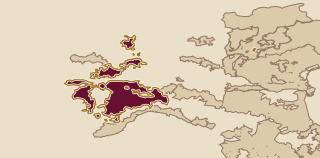
Barolo as an appellation spans eleven communes in the Langhe hills south of Alba, all growing Nebbiolo and all falling under the same DOCG designation. Within that, the commune name and the vineyard name on the label carry the real address. Monprivato in Castiglione Falletto is about as specific as a Barolo address gets.
In the cellar
Vineyards and cellar
Most of the estate's Barolo comes from Monprivato, with the Villero vineyard, also in Castiglione Falletto, first bottled as a single-vineyard wine in 1978, and Santo Stefano di Perno in Monforte providing a third main site. Farming is traditional: no shortcuts to earlier ripeness, no extraction techniques borrowed from warmer climates.
In the cellar, the Slavonian oak botti are the constant. These large casks impart no vanilla, no toast, and no new wood tannin. Long maceration extracts tannin from the grape skins directly, and the botti hold the wine during ageing without covering what the maceration produced. The botti hold the wine during long, traditional aging. Decades-old botti are actively maintained rather than retired, preserving the cellar's character from one generation to the next.
Wines to know
The range in view
Barolo Monprivato DOCG is the anchor of the range. Almost all of the 6.13-hectare vineyard belongs to the estate, and the wine is made from Nebbiolo grown on those southwest-facing Tortonian soils in Castiglione Falletto. It is aged in large Slavonian oak botti. The colour runs garnet with orange-hued highlights at the rim, which in aged Nebbiolo signals that the tannins are beginning to open. The nose is complex, fruity, and layered with spice and floral touches. On the palate, the wine shows full body with power and length. Across vintages, the character shifts from silky and fresh in years like 2009, with fine-grained tannins and ripe cherry fruit, to savoury, intensely perfumed, and concentrated in cooler vintages like 1999.
Barolo Santo Stefano di Perno DOCG comes from Monforte d'Alba and gives the range's most distinctly earthy expression. Pine, menthol, spice, graphite, and black fruit rise from the glass. The tannins are chalky, incisive, and prominent rather than silky, carrying the heavier soil signature of Monforte into the wine's whole palate.
A useful way in
A bottle to begin with
Start with Barolo Monprivato. It is the wine Mauro Mascarello separated from the blended range in 1970, the wine that comes from 6.13 hectares of southwest-facing Tortonian marl in Castiglione Falletto, and the one that shows what large Slavonian oak botti ageing does for Nebbiolo over time without adding a trace of wood character. In the glass, Monprivato is garnet with orange at the rim, complex on the nose with dried fruit, spice and a floral edge, and long and firm in the mouth with body and grip that ask for time. Give it a decade from a serious vintage, or find a bottle with ten years on it already.