
Why it matters
The producer
Alberto Graci left Milan in 2004 and came back to family land on the northeastern slopes of Mount Etna, where his relatives had farmed for generations. The decision was not sentimental. He had seen what high-altitude volcanic viticulture could produce and wanted to make wine from it. He started with five hectares, farmed at elevations between 600 and 1,000 metres under the Etna DOC appellation, and built an estate around Nerello Mascalese, the indigenous red grape that Etna's black basalt soils shape into something unlike anything grown lower on the island.
Graci now holds the position of Vice President of the Etna DOC Consorzio. The estate is among the producers most closely associated with Etna's rise in international attention over the past twenty years, and the range runs from approachable estate Etna Rosso to Quota 1000 Barbabecchi, a single-contrada bottling from ungrafted century-old vines.
Place and vineyards
Where the wines begin
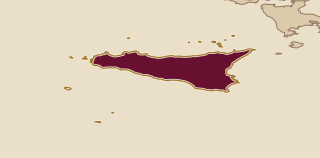
Mount Etna is an active volcano on the northeastern tip of Sicily. The Etna DOC appellation covers the slopes of the volcano across several compass points, but the northeastern side, where Graci farms, carries the combination of high elevation, cooler temperatures, and morning cloud cover that slows ripening and holds natural acidity in the grapes. The Barbabecchi vineyard contains 50-year-old, free-standing alberello vines at 1,000 metres.
Altitude on Etna is not incidental to the label. Graci's Quota 1000 Barbabecchi takes its name directly from the elevation of the Barbabecchi contrada: 1,000 metres above sea level. At that height, harvest runs into November, the nights are cold enough to fix aromatic compounds in the grape skins, and the wines arrive at lower natural alcohol than Etna bottlings from parcels at 600 or 700 metres. The volcanic basalt that covers the upper slopes adds mineral character to the tannin frame and to the finish.
In the cellar
Vineyards and cellar
Graci farms across multiple named contrade on Etna's northeastern slopes, with parcels at different elevations contributing to the range architecture. The Arcuria contrada sits above the estate level and below Barbabecchi in altitude. The Barbabecchi contrada at 1,000 metres is the highest and most demanding: ungrafted alberello vines farmed at 8,500 per hectare, no irrigation, harvest in November.
Alberello training means no wire supports and no mechanical assistance. Each vine is pruned to a low bush and carries a small number of canes. The work is entirely by hand. The low yield per vine and the high plant density together push more flavour compounds into less fruit.
Wines to know
The range in view
The range moves in three steps by altitude and vine age, each bottled under the Etna DOC appellation.
The estate Etna Rosso is 100% Nerello Mascalese from parcels at lower elevations in the Graci holdings. It is built for earlier drinking: the 2023 opens with crushed red berries, sour cherry, pomegranate, rose petals, a hint of blood orange and volcanic smoke from the basalt soils. The 2020 was supple and rounded, the fruit leaning toward ripe strawberry. Tannins are approachable and the acidity is lively without the austerity of the higher-altitude wines.
A useful way in
A bottle to begin with
Quota 1000 Barbabecchi. This is 100% Nerello Mascalese from ungrafted alberello vines at 1,000 metres, aged for 24 to 36 months in large Stockinger foudres. Every choice Graci makes in vineyard and cellar lands in this one bottle: the highest altitude parcel, the oldest and densest vines on volcanic basalt, the large-format oak that integrates without dominating, the late November harvest that concentrates flavour without losing acidity. The wine arrives with a luminous ruby depth in the glass. Small red fruits, Mediterranean herbs, mineral tones and balsamic hints on the nose; fine tannins, a marked volcanic finish, and a persistence that outlasts the pour.