
Why it matters
The producer
Graham's is a Port house in the Douro Valley with roots in the 1820s and a sourcing anchor at Quinta dos Malvedos that has held since 1890. The house covers the full Port spectrum from young Ruby styles to declared Vintage Port capable of ageing for decades. Ten members of the Symington family, spread across the fourth and fifth generations, run it today.
Two Scottish families built Graham's. The Graham merchants founded the Port business and developed Quinta dos Malvedos into their flagship estate. The Symingtons arrived later, embedded themselves in the trade, and eventually purchased the house outright in 1970 when it came up for sale. The name on the label changed; the wine sourcing and the estate network did not.
Place and vineyards
Where the wines begin
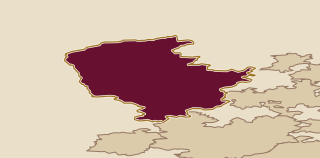
Port is a fortified wine from the Douro Valley in northern Portugal. Winemakers arrest fermentation by adding grape spirit, which kills the yeast before it converts all the sugar. What remains is a wine with residual sweetness and raised alcohol, typically between 19 and 22 percent. The Douro's schist soils and steep terraced slopes force vines deep in search of moisture, producing concentrated fruit and firm, extractable tannins. Those tannins are central to how Port ages.
Graham's draws fruit from four estates within the valley: Quinta dos Malvedos, Quinta do Tua, Quinta da Vila Velha, and Quinta do Vale de Malhadas. No specific subzone within the Douro is confirmed for the broader range. Quinta dos Malvedos sits on a promontory above the river and has supplied the core of the Vintage Port releases for over 130 years.
In the cellar
Vineyards and cellar
Port is blended from indigenous Douro varieties, most commonly Touriga Nacional, Touriga Franca, Tinta Roriz, Tinta Barroca, and Tinto Cão, though no per-wine varietal breakdown is confirmed for the Graham's range. Fermentation is interrupted by the addition of grape spirit, and the young wine then goes into wood. How long it stays in wood and what happens to it there determines the style.
For Tawny, the wine spends years in small seasoned oak casks, where oxygen slowly bleaches the red pigment, softens the fruit toward dried and nutty character, and pulls the colour from deep ruby toward amber. The 20 Year Old Tawny is aged an average of twenty years in those casks before bottling. For Vintage Port, the wine spends roughly two years in wood and then decades in bottle, where it develops at a much slower, lower-oxygen rate. Late Bottled Vintage sits between those extremes: four to six years in wood, then bottled for relatively early drinking.
Wines to know
The range in view
Graham's range follows the three main Port styles, each shaped by a different ageing path.
The Vintage Port is declared only in exceptional years and sourced primarily from Quinta dos Malvedos. The 2024 carries red and black fruit aromas with mint, eucalyptus, and rockrose on the nose. The palate runs to kirsch, black plum, and liquorice with polished tannins. Vintage Port at this level is bottled with the expectation of further ageing; the tannins are grippy and the fruit concentrated enough to sustain many more years in bottle.
A useful way in
A bottle to begin with
Start with the 20 Year Old Tawny. It is the bottle that shows most clearly what time and wood do to Port: the colour shifts toward amber, the fresh fruit gives way to walnuts and orange peel, and the palate becomes smooth and softly sweet rather than tannic and gripping. Two decades in seasoned oak casks shaped every detail in the glass. A single pour explains the oxidative ageing logic that defines one whole branch of Port, and the wine is drinkable without needing food or occasion to justify it.