
Why it matters
The producer
Gran Clos farms 32 hectares of grenache, carignan, and white varieties in Priorat, the DOQ appellation in southern Catalonia where volcanic slate soils and near-vertical terraces make viticulture genuinely difficult and the wines correspondingly concentrated. The estate began in 1995 when Josep Maria Fuentes chose to revive old grenache and carignan vineyards rather than replant them, keeping root systems that now push well past a century of age.
In 2002, British buyer John Hunt acquired the estate, renamed it from Celler Fuentes to Gran Clos, and brought in Josep Angel Mestre as winemaker. Mestre arrived with formal training in agricultural engineering, enology, and winemaking from France, skills not common in what was still a mostly regional producer landscape. The name Celler Fuentes became Gran Clos. Over the following two decades, the combination of old vines, technically grounded winemaking, and international ambition moved Gran Clos from a local address to a Priorat producer ranked top in a ten-year blind tasting judged by critics, sommeliers, and international judges, and named to Wine and Spirits magazine's Top 100 Winery list in 2020.
Place and vineyards
Where the wines begin
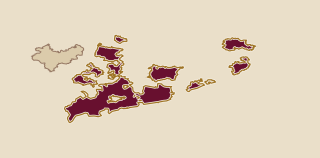
Priorat sits inland from Tarragona, hemmed by the Serra del Montsant range. The DOQ classification, one of only two in Spain with that status, covers a tight cluster of villages in the Siurana river valley. What separates Priorat from the broader Montsant appellation surrounding it is primarily the llicorella: a fractured black slate and quartz soil that drains fast, forces vines deep, and returns wines with a mineral density and dark fruit weight that is hard to find elsewhere on the Iberian Peninsula.
The slate drains so aggressively that vines without old root systems cannot manage dry summers without irrigation. Old-vine grenache on llicorella solves this differently: roots mine meters into the fractured rock, finding moisture and minerals that younger plantings cannot reach. Low yields follow naturally, and the fruit that does form carries the kind of concentration and flavour depth that explains why Priorat commanded a DOQ designation.
In the cellar
Vineyards and cellar
The oldest vines on the estate are grenache, some exceeding a century. Old vines on llicorella produce smaller, more concentrated fruit than younger plantings: less juice per cluster, more skin-to-juice contact, more extraction of the mineral and dark-fruit character the slate contributes. Syrah is planted as a blending component rather than a stand-alone variety.
Finca El Puig, the flagship red, ages 13 to 15 months in French oak. Oak at this duration integrates into the wine rather than dominating it: the dark fruit, pepper, and balsamic notes that come from old-vine grenache on slate survive the ageing process and remain the primary character of the wine. Gran Clos Blanc ages on lees in French oak, a method that adds texture and a faint creaminess to the mid-palate without covering the mineral and herb notes that the garnacha blanca contributes.
Wines to know
The range in view
Finca El Puig is the estate's primary red wine, a blend of 73% Garnacha, 17% Syrah, and 10% Cariñena aged 13 to 15 months in French oak. Across vintages it carries red and black fruit, balsamic, floral notes, and a peppery quality from the syrah and the slate. The 2013 tasted ripe and well-knit, with fresh red and black fruits, forest herb, and a fruity, well-balanced palate with fine tannin. The 2022 came across as younger and tighter: damson, dusty earth, blackberry, and pepper on the nose; peppery black fruit, warmth, and a clean bitter touch on the finish.
Gran Clos Blanc is the white wine, a blend of 76% Garnacha Blanca and 24% Macabeo, lees-aged in French oak. It pours luminous straw yellow with a golden rim and offers complex aromas of peach, quince, herbs, and balsamic with an underlying mineral thread.
A useful way in
A bottle to begin with
Start with Finca El Puig. It is 73% old-vine grenache grown on llicorella, blended with syrah and carignan, and aged 13 to 15 months in French oak: a direct expression of what Priorat slate does to grenache at vine age. The wine opens with dark fruit, pepper, and earth, builds to a warm, concentrated mid-palate, and finishes with a bitter edge from the carignan. It is not a light wine: the slate, the vine age, and the climate all point toward weight and flavour density. Give a young vintage three to five years, or seek out an older vintage to see what the wine becomes when the fruit opens and the oak fully integrates.