
Why it matters
The producer
Clemente Guasti founded his estate in 1946, immediately after the war, in the town of Nizza Monferrato in the Monferrato hills of southeastern Piemonte. The winery has stayed at the same address on Via IV Novembre ever since. His grandson Enrico Piantato now runs it.
Two decisions from the founding generation set the estate apart from most of its neighbours. First, Clemente began printing the vineyard origin of his grapes on Barbera bottle labels at a time when most Barbera in the region left in bulk with no such detail recorded. Second, he installed steel autoclaves for Martinotti-Charmat sparkling production before this was common in Nizza Monferrato, positioning the estate across three quite different wine categories from an early stage.
Place and vineyards
Where the wines begin
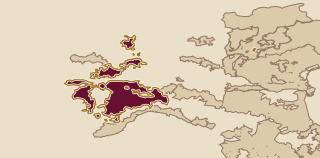
Nizza Monferrato is a market town in the Asti province of southern Piemonte, sitting in the rolling Monferrato hills between the Tanaro river and the higher Langhe to the southwest. The area is Barbera country: the grape covers the hillside vineyards here more thoroughly than anywhere else in Piemonte, and the Nizza DOCG, established in 2014 as a sub-zone of Barbera d'Asti Superiore, formalised the argument that the best Barbera from these hills deserved its own appellation and production rules.
Nizza DOCG requires higher minimum alcohol, lower yields, and longer aging than standard Barbera d'Asti. The Riserva category within Nizza adds a further minimum aging requirement. These rules translate directly to the label: a bottle marked Nizza Riserva comes from a stricter selection, older vines, and more time in cellar than a simple Barbera d'Asti.
In the cellar
Vineyards and cellar
Nizza Barcarato is made from Barbera selected from the oldest parcels on the estate, chosen at peak ripeness. Oak aging is calibrated to build tannin and body without obscuring the aromatic character of old-vine Barbera. The tannin in the finished wine comes from the barrel time rather than from the grape itself, since Barbera carries little natural tannin. Getting the barrel contact right is the central cellar question for this style: too little and the wine lacks grip; too much and the fruit is buried.
The Barolo draws on Nebbiolo from Barolo and Serralunga d'Alba, blending across those two soil types, and spends two and a half years in oak before release. Three Nebbiolo subvarieties are in the blend: Lampia, Michet, and Ros. Each contributes differently to the final wine, Michet being smaller-berried and more concentrated, Lampia more perfumed and open in character.
Wines to know
The range in view
Nizza Barcarato (Nizza DOCG Riserva): 100% Barbera from the estate's oldest vines. The nose leads with sweet violet, persistent and strong. On the palate the wine is full-bodied and robust, with tannin from oak aging. The calibrated barrel time produces a wine that can hold its shape across a meal rather than drinking entirely on fruit in the first pour.
Barolo: 100% Nebbiolo, blended from three subvarieties: Lampia, Michet, and Ros. Sourced across Barolo and Serralunga d'Alba, the wine combines the more approachable aromatic register of Tortonian-soil Nebbiolo with the firmer, longer-aging potential of Serralunga fruit. Two and a half years in oak gives the wine substantial secondary development: dried rose, tar, tobacco, and the characteristic bitter cherry finish that defines classic Barolo.
A useful way in
A bottle to begin with
Nizza Barcarato Riserva is the right starting point. It is 100% Barbera from the estate's oldest vines, produced under the Nizza DOCG rules that set minimum aging and vineyard standards above ordinary Barbera d'Asti. The wine opens with sweet violet and dark fruit, moves to a full, tannin-framed palate from the calibrated oak contact, and finishes with the bright acidity that is Barbera's most distinctive character: the combination keeps the wine from feeling heavy despite its weight.