
Why it matters
The producer
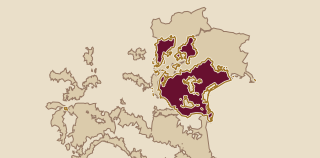
Guerrieri Rizzardi holds a position that very few Veneto estates can claim: vineyards and working cellars in four of the region's Classico appellations, all farmed with the producer's own grapes. The estate spans Bardolino on the eastern shore of Lake Garda, Valpolicella in the hills northwest of Verona, Soave on volcanic ground to the east, and Valdadige along the river valley that links them. Each zone has its own cellar. No grapes are bought in.
The oldest of those cellars is at Pojega in the Valpolicella village of Negrar, purchased by Carlo Rizzardi in 1649. The Rizzardi family first bottled wine under their own label in 1678. In 1913 they merged with the Guerrieri family, Counts of Bardolino, whose land investments along the lake and in Valdadige dated to the early seventeenth century. The administrative and production hub moved to Strada Campazzi in Bardolino in 2010, with a wine shop opening there in 2012, but Pojega remains the Valpolicella heart: an active cellar on the same ground it has occupied for over three and a half centuries.
Place and vineyards
Where the wines begin
The four Classico appellations cluster around Verona but face different directions and grow on different ground. Bardolino sits on glacial and alluvial soils on the Garda moraine, producing lighter reds from Corvina and Rondinella where cool lake breezes keep acidity high. Valpolicella occupies a series of valleys running north into the Lessini foothills, with calcareous and volcanic soils at Negrar giving good depth to Corvina-based wines. Soave lies east of Verona on the Monte Lessini volcanic belt, where basalt and volcanic tuff favour Garganega, keeping wines mineral and aromatic even in warm years. Valdadige follows the Adige river north toward Trentino.
Pojega in Negrar covers 25 hectares on volcanic and calcareous soils in the Classico zone. The volcanic component is basalt-rich, retaining heat and shaping the dark fruit concentration in Valpolicella and Amarone from this estate. Calcareous layers add drainage and keep acidity present through the growing season.
In the cellar
Vineyards and cellar
Guerrieri Rizzardi picks all fruit by hand across all four appellations. In Valpolicella and for Amarone, hand-sorting follows harvest, and the dried-grape process that defines Amarone begins immediately after picking: the Corvina-dominant blend is laid out to dry, concentrating sugar, colour, and fruit intensity before fermentation. Amarone Calcarole then ferments slowly over one month, with malolactic fermentation carried out in oak. Barrel ageing runs 12 months in small 5-hectolitre oak casks, then a further 24 months in larger 25-hectolitre barrels, 36 months in wood before release.
The Ripasso Pojega takes a different cellar route. After hand-picking and a 10-day fermentation and maceration, the base Valpolicella wine is re-fermented over the pressed skins left from Amarone production. This second contact with Amarone pomace adds body, dark fruit concentration, and a degree of the dried-grape character without the full weight of Amarone. After the ripasso step, the wine ages 12 months in French oak barrels.
Wines to know
The range in view
The range runs across four appellations and four distinct styles. At the lightest end, the Delara Montebaldo Bardolino is Corvina and Rondinella aged in stainless steel without oak: a pale, unoaked red with cherry fruit, light spice, silky tannins, and a mineral edge from the glacial Garda soils. It is the least demanding bottle in the range and the most direct expression of Bardolino's lake-cooled character.
The Ferra Soave Classico is 100% Garganega from the single volcanic-soil vineyard near the Castle of Soave, made only in exceptional vintages. Six months in large oak foudres give a very light wood note; the dominant character is aromatic and mineral, with jasmine, green herbs, mango, and pear, underscored by the lifted acidity that volcanic Garganega carries naturally.
A useful way in
A bottle to begin with
Start with the Ripasso Pojega. It is re-fermented over Amarone skins and aged 12 months in French oak. The re-fermentation step adds dark fruit concentration and body without the full dried-grape weight of Amarone, making the wine richer and more serious than a base Valpolicella while remaining approachable on release. Dark cherry, plum, sweet spice, a rounded texture, and a fresh finish. Its re-fermentation uses the pressed skins left from Amarone production. Once you know that, the Amarone Calcarole makes sense as the next step rather than a different category entirely.