
Why it matters
The producer
Gulfi came out of a chemical industry entrepreneur's bet on a grape that most of Sicily was either selling in bulk or blending away. Vito Catania founded the estate in 1996 in Chiaramonte Gulfi, a hill town above the Ragusa plain, with a thesis rather than a winemaking career: Nero d'Avola, the island's principal red grape, was not one wine but several, and the place it grew in would prove it.
He bought parcels in four named contradas around Pachino, the flat southeastern peninsula where Nero d'Avola has its deepest historical roots, and bottled each separately. Four crus from the same grape, the same estate, the same vintage, but different soils and different wines. At the time, in the late 1990s, that was not how Sicilian Nero d'Avola worked.
Place and vineyards
Where the wines begin
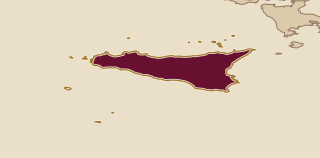
Pachino sits at Sicily's southeastern tip, a flat limestone and marl peninsula where the sea is never far in any direction. The climate is hot and dry, and without irrigation, vines have no choice but to grow downward. Gulfi's alberello vines push roots into marl and limestone bedrock to find moisture.
The IGT Sicilia designation covers the four contrada crus and the white Valcanzjria. Cerasuolo di Vittoria DOCG, Sicily's only DOCG appellation, comes from the Vittoria zone within Ragusa province, where the regulations require a blend of Nero d'Avola and Frappato.
In the cellar
Vineyards and cellar
Alberello vines at Gulfi are farmed without irrigation across all 70 hectares. Hand harvesting allows parcel-by-parcel selection rather than machine averaging across a contrada. Each cru is vinified separately from picking through bottling, which is the only way the contrada differences can survive into the glass.
Fermentation uses native yeasts in stainless steel tanks.
Wines to know
The range in view
The four Nero d'Avola crus are the estate's core, each labelled with the contrada name: NeroMaccarj (Maccaraj contrada), NeroBufaleffj (Bufaleffj contrada), NeroBaronj (Baronj contrada), and NeroSanloré (Sanlorè contrada). All four are IGT Sicilia, all four from Pachino, all four fermented with native yeast in stainless steel tanks. The differences between them come from soil and microclimate rather than from cellar intervention.
NeroBufaleffj shows the darker end of the range: dark chocolate, baked black plum, cherry stone, blueberry, and almond essence in successive layers. NeroSanloré moves toward fresh red and dark fruit together, with dried citrus peel, wild herbs, and balsamic lift. Where Bufaleffj is dense and inward, Sanloré has more air around the fruit.
A useful way in
A bottle to begin with
NeroSanloré is the right first bottle. It is Gulfi's highest-scoring cru, 96 points from Jacky Blisson on the 2017, and it shows what the estate's method produces at its most expressive: fresh red and dark fruit from Nero d'Avola grown on Pachino limestone, dried citrus peel and wild herbs, balsamic lift, and a finish that is long and dry without being heavy. The acidity is more open than Bufaleffj. Buy it with four or five years in the cellar if possible; it will gain complexity without losing its current freshness.