
Why it matters
The producer
Gute Vingård farms 17,000 vines on Gotland's southern tip, at Näsudden in the parish of Havdhem, on a limestone island in the Baltic Sea. The estate grows three hybrid varieties: Solaris and Phönix for white wine, and Rondo for rosé. No chemical pesticides are used. All fruit is harvested by hand in late summer.
The range is compact: Ekat, a still white with oak contact and a mineral, apple-and-pear profile; Levide Rosé, a dry single-variety Rondo made entirely in stainless steel; and Wisby Mousserande, a sparkling wine. Winemaking draws on collaboration with partners from both Sweden and Italy. A tasting room, restaurant, and farm hotel share the property.
Place and vineyards
Where the wines begin
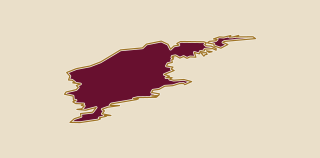
Gotland sits in the Baltic Sea roughly 90 kilometres east of the Swedish mainland. The island is built on Silurian-period limestone, an ancient seabed geology that pulls the soil pH toward alkaline and gives both farming and fermentation a different baseline than most Swedish wine regions. The Baltic moderates temperature enough that a growing season exists at this latitude, but summers are shorter and cooler than in central Europe, and ripening demands grape varieties bred for exactly those conditions.
Gotland carries no formal Swedish wine appellation designation. Wines from the island are labelled by producer and wine name, not by a legally defined place of origin. The island's geographic designation functions as provenance in the marketplace rather than a protected category on the label.
In the cellar
Vineyards and cellar
Solaris and Phönix are the white-wine base. Both varieties were bred to resist mildew and botrytis in cool, damp climates, and their disease-resistance means the ecological farming commitment at Gute Vingård is practically achievable where it would be difficult with classic European varieties. The grapes ripen with reasonable acidity and a fruit character that leans toward green and stone fruits rather than tropical weight.
Rondo, the red hybrid used for Levide Rosé, carries deeper colour and thicker skin than most hybrid red grapes. Using it only for rosé rather than red wine is a deliberate choice: the variety's tannic potential stays in the background when extraction is kept short, and what remains is colour, acid, and a dry, structured pink wine rather than a heavy or unbalanced one.
Wines to know
The range in view
The confirmed range covers three bottles.
Ekat is the estate white, described with green apple and pear fruit, a mineral-fruity character, and complexity from oak contact. The hybrid base of Solaris and Phönix gives the wine a cool-climate freshness, and the oak rounds the texture without burying the fruit. Oak contact rounds the texture without burying the fruit.
A useful way in
A bottle to begin with
Start with Levide Rosé. It is a single-variety Rondo from Gotland limestone, made entirely in stainless steel with no added sugar and a residual sugar level so low it registers as dry in the mouth. The acidity is higher than the Swedish rosé average, and the wine can be cellared for up to three years, which is unusual for any contemporary rosé and practically unheard of for a Swedish one. Pouring it tells you what the island geology and the Rondo hybrid can do when the winemaking steps back. It was named rosé wine of the year by Dagens Industri. That is where to begin.