
Why it matters
The producer
Håkan Hansson planted his first vine in 2003 on land the Hansson family had farmed for five generations in southern Skåne. The family had no wine background on that land. What they had was acreage at the edge of viable viticulture and a decision to do something with it that had almost no precedent in Sweden at the time.
Twenty years later, Hällåkra Vingård covers 6.5 hectares of cold-climate hybrid vines, produces a full range from sparkling to sweet, and sells to Noma in Copenhagen and Bhoga in Gothenburg. Noma and Bhoga are not novelty buyers. Both restaurants build their wine lists around provenance and technical quality. Hällåkra made it onto those lists on the merits of the wine.
Place and vineyards
Where the wines begin
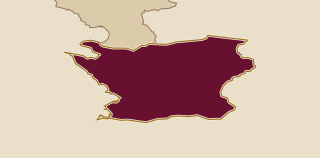
Skåne is Sweden's southernmost province, and its climate is the most temperate in the country. That still means a short growing season, cool summers, and a hard limit on which grape varieties will ripen at all. Conventional European varieties are not the answer at this latitude. Hällåkra plants cold-climate hybrids bred specifically for northern conditions: Solaris for whites and sparkling, Rondo alongside Regent and Leon Millot for reds.
These are not substitutions for more famous grapes. They are the answer to the specific conditions in Skåne. Solaris ripens reliably even in cool years and carries high natural acidity with significant aromatic complexity. Rondo produces firm tannin and concentrated dark fruit in a red wine context. Regent and Leon Millot add colour and blending depth. The choice of variety is inseparable from the place: grow Chardonnay in Skåne and you wait for a ripeness that may never arrive. Grow Solaris and you have a wine.
In the cellar
Vineyards and cellar
Hällåkra farms biodynamically, without confirmation of certification yet. In the cellar, the approach is minimal intervention throughout. Fermentation uses only indigenous yeasts, with no additions to trigger or accelerate the process. The wines are not filtered or clarified before bottling. Sulphites are not added to the base wines.
The practical consequence of this approach is that the fruit character of the hybrid varieties comes through without oak or sulphur masking it. Solaris under indigenous yeast fermentation with no filtration produces a wine with textural grip and aromatic complexity rather than the clean, neutral profile that heavy processing might deliver. The Rondo-based reds carry tannin from the grape itself, not from wood management.
Wines to know
The range in view
Hällåkra makes five categories: red, white, orange, sparkling and sweet. The white and sparkling range is built on Solaris. The red range uses Rondo as the dominant variety with Regent and Leon Millot in supporting roles.
Anna 2024 is the still white: 100% Solaris, spicy and very fresh with notable astringency. The glass gives winter apples, dried herbs, light bread, lingonberries, caraway seeds, nuts, orange peel and apricot. The astringency comes from skin contact time and the variety's own phenolic character. It is not a delicate white.
A useful way in
A bottle to begin with
Anna 2024 is the right first bottle. It is 100% Solaris, the variety that defines what Hällåkra does with its 6.5 hectares of white and sparkling wine land, and it is made with no additions and no filtration, so what you taste is the grape, the indigenous fermentation, and the place. The spiced freshness is immediate. Winter apples, caraway, orange peel and dried herbs arrive together rather than in sequence. The astringency on the finish is real but not aggressive, and it tells you something accurate about how this variety behaves in Skåne: it does not round off into comfort. It stays angular and aromatic and alive.