
Why it matters
The producer
Heitz Cellar did something in 1966 that the rest of Napa Valley had not yet thought to do. Joe Heitz bottled a Cabernet Sauvignon under the name of a single vineyard in Oakville, called it Martha's Vineyard, and put it on the label. There was no legal appellation framework requiring that, no established market for it, and no precedent in California. Joe simply believed the parcel was particular enough to deserve its own name.
The estate sits in St. Helena, founded in 1961 by Joe and Alice Heitz. For most of the following six decades, it grew into a house defined by that founding instinct: name the vineyard, age the wine properly, and release it when it is ready. The red wines wait up to six years from harvest before leaving the cellar, which includes time in barrel and extended bottle aging. That kind of patience is uncommon in Napa Valley now.
Place and vineyards
Where the wines begin
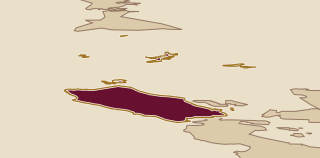
Napa Valley is a long corridor running roughly northwest to southeast between two mountain ranges in Sonoma County. Within that corridor, Heitz draws from six of the valley's named sub-appellations: Oakville, Rutherford, St. Helena, Howell Mountain, Oak Knoll District, and Calistoga. Each carries different soil character and elevation.
Oakville, where Martha's Vineyard sits, is mid-valley floor, a warm and deep-soiled address that produces Cabernet with full fruit and enough depth to reward long aging. Rutherford, where Trailside Vineyard runs along a slope toward Conn Creek, is alluvial river deposit, well-drained and warm. Howell Mountain, where Linda Falls Vineyard sits, is elevated volcanic terrain above the fog line with significantly firmer tannin than any valley floor site. The altitude extends the growing season and slows ripening, giving the Cabernet different tannic weight and acid freshness.
In the cellar
Vineyards and cellar
All estate vineyards hold CCOF certification, California's leading organic farming standard. The certification applies across all six sub-appellations.
The aging protocol defines the house as much as any vineyard. Red wines spend up to six years from harvest to release, including barrel aging followed by extended bottle aging in the cellar. Most Napa Cabernet reaches market within two to four years of vintage. The Heitz approach means the wine has already resolved some of its primary tannin and integrated its oak by the time a buyer opens it. The release is also the signal that the cellar considers the wine ready.
Wines to know
The range in view
The range is built almost entirely on Cabernet Sauvignon across the three named single-vineyard wines and an estate-level Napa Valley Cabernet.
Martha's Vineyard Cabernet Sauvignon, Oakville. The founding wine and the one that established the vineyard-designation model. Cherry aromatics on the nose, a mid-palate shaped by the warmth and depth of Oakville's valley floor soils, and the depth that comes from extended aging in the cellar before release.
A useful way in
A bottle to begin with
Martha's Vineyard Cabernet Sauvignon, Oakville, is the first bottle. It is the wine that started the house's argument, and every decision Heitz makes about single-vineyard Cabernet traces back to what Joe Heitz tasted from that Oakville parcel in the mid-1960s. Cherry aromatics rise on the nose, clean and direct. The palate is full, shaped by Oakville's deep valley floor soils, with the integration that comes from six years of pre-release aging. No sharp edges. Tannins present but resolved. A wine that is ready when you open it and built to develop further if you put it down.