
Why it matters
The producer
Henkell is the house that industrialised German sparkling wine before the category had a name. Adam Henkell spent twenty-four years trading Rhine wine in export markets before he stopped selling other people's bottles and commissioned his own factory. In 1856, on Walpodenstrasse in Mainz, he began producing sparkling wine in a purpose-built facility modelled on the Champagne houses he had been watching across the border. Fifty years later, Henkell was filling three million bottles a year.
The house operates today from Biebrich on the Rhine, under the Oetker Group, and its flagship, Henkell Trocken, is one of the most widely recognised sparkling wine labels in Germany. A secondary range, Tareq Taylor Riesling, draws fruit from the Rheingau, the cool stretch of Rhine-facing slopes where Riesling has been planted since the medieval period.
Place and vineyards
Where the wines begin
Sekt is the German category for quality sparkling wine, made from grapes grown in any of the recognised German wine regions. Unlike Champagne, which is tied to a single appellation and its chalk soils, Sekt carries no mandatory origin requirement at the basic level: grape sourcing can span regions, and even international fruit is permitted in some tiers. Henkell Trocken is a non-vintage blend; the grape varieties in the cuvée are not declared on the label.
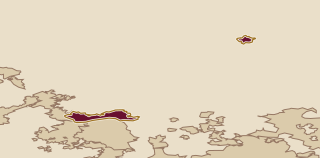
The Tareq Taylor Riesling line carries a Rheingau origin. The Rheingau is a concentrated wine region on the north bank of the Rhine, west of Wiesbaden, where south-facing slopes and the moderating effect of the river push Riesling to full ripeness while holding acidity. Wines from this address tend toward stone fruit and citrus at low altitudes, with firmer acid lines on the higher, quartzite-heavy plots.
In the cellar
Vineyards and cellar
Henkell Trocken is made by the Charmat method, also called cuve close or tank method: the wine undergoes secondary fermentation in a pressurised stainless steel tank rather than in individual bottles. This is the standard production method for volume Sekt and distinguishes it from traditional method sparkling wines, where secondary fermentation and extended lees ageing happen in the bottle. Charmat is faster, more predictable, and suited to preserving fresh fruit aromas: apple, citrus, and floral notes are easier to carry through tank fermentation than through extended bottle contact.
The Tareq Taylor Riesling is produced separately, from Rheingau fruit, and carries 0.4 g/100ml residual sugar, which places it firmly in the dry category. It is not a Charmat wine in the same sense: it is a still Riesling made under a licensed collaboration.
Wines to know
The range in view
Henkell Trocken is the house's defining product: a non-vintage Sekt made by the Charmat method in stainless steel, with a grape composition that is not declared on the label. At 22 g/l residual sugar, it lands between the flavour profile of a dry wine and the approachability of a sweeter one. The nose opens with green apple, lemon, golden apple, white flowers, and a trace of apricot. The palate is frothy, with bright acidity and citrus running through the centre. The finish is short. This is not a wine built for complexity or extended tasting: it is built for immediate enjoyment, consistent year on year, at a price point that reflects mass production.
Tareq Taylor Riesling is a Rheingau still white wine produced under a licensed arrangement. At 12% alcohol and 0.4 g/100ml residual sugar, it is dry. Tasting notes describe pear, green apples, peach, and lemon, with a fruity and fresh character. The label does not name specific vineyard sources, and it functions as a branded collaboration rather than a grower Riesling with a documented parcels story.
A useful way in
A bottle to begin with
Henkell Trocken is the bottle to open. It is not the most ambitious wine in the Henkell range, but it is the one that explains what this house has always been: a large-scale Sekt producer engineering a consistent, crowd-friendly sparkling wine for broad markets. Charmat method, stainless steel, 22 g/l residual sugar, non-vintage blend. The apple and lemon aromatics are immediate, the mousse is frothy, and the acidity keeps the slight sweetness from feeling heavy. The finish is short, which is honest: this wine is designed for an occasion, not for a long session in the glass.