
Why it matters
The producer
Herdade de Medeiros sits in Moura, at the southern edge of the Alentejo, closer to the Spanish border than to Évora. The Figueira de Chaves family has farmed these 39 hectares for a period the family counts in centuries and the archives confirm from 1795. In a region where many estates spent most of the twentieth century selling anonymous wine into cooperative tanks, Medeiros has a paper record stretching back to a time when most of its neighbours had none.
The family farms without synthetic pesticides or herbicides and keeps the land around the vineyard as a working habitat for wildlife, including migratory bird species that pass through each year. The approach is less a marketing position than a physical commitment to the land. Grapes are hand-harvested, and the wines go through barrel ageing before bottling.
Place and vineyards
Where the wines begin
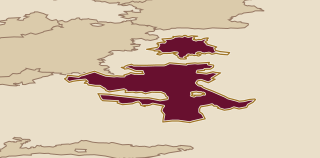
Moura is in Baixo Alentejo, the lower, drier stretch of the region that runs toward the Guadiana river and the Spanish border. The town sits at an elevation that catches occasional Atlantic influence from the west without losing the warm, dry continental character that defines most of southern Portugal in summer. Nights cool noticeably, which matters for acidity and the aromatic development of dark-fruited varieties like Alicante Bouschet.
The Alentejo appellation covers a wide area, and Moura sits at its southeastern limit. The surrounding landscape is open and sparsely farmed, with cork oak, scrubland, and the kind of quiet that supports the estate's role as a wildlife corridor. That landscape is not incidental to the wine: farming without synthetic inputs at this scale, in this climate, is a logistical fact that shapes both the vineyard and what appears on the label.
In the cellar
Vineyards and cellar
Hand-harvesting at 39 hectares in the summer heat of Baixo Alentejo is a significant commitment. Mechanical harvesting is faster and cheaper; hand-harvesting means the fruit arrives at the cellar intact, without the oxidation and berry breakage that mechanical pickers can introduce. The teinturier pigment lives in the flesh, and the wine has broad yet fine tannins.
After harvest, the wine goes into barrel for ageing. The wood type and ageing duration are not specified, but the effect is audible in the wine: the long savoury finish and the bittersweet chocolate note that emerges behind the dark fruit are consistent with time in oak. The tannins arrive broad rather than angular, which suggests a cellar approach that softens rather than amplifies the grape's natural grip.
Wines to know
The range in view
The confirmed wine in the Medeiros portfolio is the Alicante Bouschet, a 100% monovarietal red. Alicante Bouschet is one of very few grape varieties in the world where both skin and flesh carry red pigment, which gives the wine an opaque ruby-purple colour that deepens toward black at the centre of the glass. The nose layers blackberry, mulberry, and black cherry across a base of cocoa, licorice, and dried wild herbs. The palate is built around dark fruit held in place by broad but fine tannins, with lively acidity running through the mid-palate.
The finish is long and savoury, with bittersweet chocolate and forest berry notes extending well past the swallow. This is a wine with body and length: it is not a light, aromatic style, and it is not made to be drunk young without food. The monovarietal decision means the bottle carries the character of a single grape in full rather than modulating it through blending.
A useful way in
A bottle to begin with
The Medeiros Alicante Bouschet 2021 is the right place to start. It is 100% Alicante Bouschet, hand-harvested from 39 hectares in Moura and barrel aged before bottling. In the glass it is opaque and dark-fruited, with blackberry and mulberry on the nose, broad tannins on the palate, and a long finish that moves from bittersweet chocolate into forest berries. The grape's teinturier character means both the colour and the depth of flavour are intrinsic, not constructed through blending.