
Why it matters
The producer
Herdade do Sobroso covers 1,600 hectares in the Vidigueira municipality of southern Alentejo, making it one of the larger estate properties in a region already defined by scale. Winemaker Filipe Teixeira has spent the past fifteen-plus years steering the estate away from conventional large-property agriculture toward something more considered: indigenous Portuguese grapes, soil fed by sheep and cow manure rather than synthetic fertilisers, and a slow replanting of the landscape with cork oak. The wines follow from those choices. They are Alentejo reds in the fullest sense, built from the thick-skinned native varieties that thrive under the region's heat, and whites anchored by Antão Vaz, a grape that keeps freshness where the climate could easily strip it.
The range runs from a Reserva tier intended as the accessible core to a top Élevage collection and an oak-aged aguardente grape spirit. Each level draws from the same estate parcels, the same farming philosophy, and the same four red varieties that Teixeira has treated as the estate's primary material.
Place and vineyards
Where the wines begin
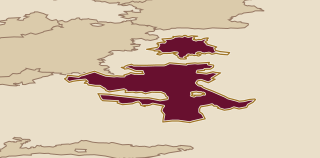
Vidigueira sits in the southeast of Alentejo, roughly between Beja to the west and the Spanish border to the east. The Serra do Mendro, a low granite ridge, runs along the northern edge of the estate. The Guadiana River, which forms part of the Portuguese-Spanish border further south, flows along the eastern boundary. Lake Alqueva, the reservoir created by a dam on the Guadiana completed in 2002, lies nearby and moderates temperatures across the surrounding plain by acting as a thermal mass against the summer heat.
Alentejo DOC is one of Portugal's broadest inland appellations, covering most of the country's hot, low-rainfall interior south of the Tagus. The climate selects for grapes that can manage heat and develop full colour and extract without the water stress that collapses thinner-skinned varieties. Aragonez, Trincadeira, Alicante Bouschet, and Alfrocheiro are all suited to these conditions and are the backbone of almost every serious red wine made under the DOC Alentejo label.
In the cellar
Vineyards and cellar
Soil fertility at Herdade do Sobroso comes from sheep and cow manure, applied across the estate's vineyards. Synthetic fertilisers are not used. Pesticide use is kept to a minimum. The cork oak planting has continued steadily, and the oldest trees now provide genuine canopy and soil cover across significant portions of the estate.
In the cellar, the Élevage collection signals the estate's highest level of ambition. The name is deliberate: the estate defines élevage as the moment a wine "comes into being, developing its full potential." At the spirit end of the range, Arche Aguardente Vinica spends more than ten years ageing in Allier French oak casks before release. That duration is unusual for a Portuguese grape spirit and places it well outside the standard aguardente category in terms of oak integration and development.
Wines to know
The range in view
The Reserva tier is the estate's core range, produced in both red and white. The Reserva Red blends Aragonez, Trincadeira, Alicante Bouschet, and Alfrocheiro: four grapes that each contribute differently. Aragonez (the local name for Tempranillo) brings red fruit and body. Trincadeira contributes spice and tannin. Alicante Bouschet, one of the few red-fleshed grape varieties, deepens the colour and adds weight. Alfrocheiro rounds the blend with darker fruit and aromatic lift. A garnet wine follows, with blackcurrant, blueberry, grass and spice on the nose, cocoa and jam from the riper fruit, and a smooth, well-built palate with soft tannins and balanced acidity.
The Reserva White is Antão Vaz-led, a white Alentejo variety that holds on to floral character and tropical fruit even in hot conditions. The colour is clear citrine. The palate gives freshness and intensity without the flatness that warm-climate whites often carry.
A useful way in
A bottle to begin with
Start with the Reserva Red. It blends all four of the estate's core indigenous grapes in a single bottle, Aragonez and Trincadeira leading the blend, Alicante Bouschet deepening the colour and weight, Alfrocheiro adding aromatic complexity. On the nose, blackcurrant and blueberry come first, with spice underneath and a cocoa note from the ripest fruit. The palate is smooth, the tannins soft, the acidity balanced, the finish long. It is the most direct route into what Sobroso farms and how Alentejo's heat translates into a bottle, without requiring any prior knowledge of the estate.