
Why it matters
The producer
Jesper Friberg makes wine from rented coastal parcels in Skåne, Sweden's southernmost province, while working as a roof thatcher to fund the operation. No estate winery, no investor capital, no owned land. He rents plots, buys fruit from young growers building their own projects, and between harvests climbs onto rooftops to keep the finances level. The wines that result from this arrangement are tightly made, fresh, and structurally honest about the cold latitude they come from.
Friberg farms two sites. The primary parcel sits in Österlen on Skåne's east coast near the fishing town of Kivik, where the Baltic moderates summer temperatures and extends the growing season without generating enough warmth for conventional wine grapes. His second site, added in 2023, is at Klagshamn on the coast just south of Malmö, where the land is flat and the sea proximity works the same way. Both locations grow Solaris, a cold-hardy hybrid grape bred specifically for northern European viticulture: it ripens at latitudes that would leave Chardonnay or Riesling chronically underripe.
Place and vineyards
Where the wines begin
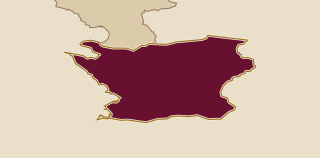
Skåne is a flat agricultural province at the southern tip of Sweden, separated from Denmark by the narrow Øresund strait. Wine has been grown here commercially since the 1990s, but the region operates without an established appellation framework. There are no classified growths, no formally demarcated sub-regions, and no grape variety requirements. Producers choose what to plant and how to label, which gives growers latitude but removes the shared recognition that builds regional familiarity.
The coastal position of both Friberg sites matters to the wine. Sea air and maritime breezes slow ripening, keeping acidity high and alcohol moderate. Skåne's short growing season demands a grape that accumulates sugar quickly once conditions allow, and Solaris delivers on that count: it reaches physiological maturity before autumn cold arrives, while keeping the freshness of the wines.
In the cellar
Vineyards and cellar
The vineyard work uses no synthetic herbicides, pesticides, or fungicides. Friberg applies herbal teas and microorganism preparations to maintain soil biology and vine health. In a wet northern European climate where fungal pressure on vines is high, Solaris earns its place partly because the grape has built-in disease resistance: it was bred to withstand the conditions that would destroy vinifera varieties at this latitude.
In the cellar, Fjälltopp is fermented and aged across three vessel types: oak barrels, an egg-shaped concrete or clay tank, and stainless steel. Each vessel interacts differently with the wine. Oak adds a slight oxidative element and can lend texture. The egg shape encourages gentle lees movement without oxygen uptake. Stainless steel preserves direct fruit and acidity without adding anything of its own. The three together produce a white wine with more textural complexity than any single vessel would generate, while the stainless component preserves the freshness that cold-climate Solaris naturally delivers.
Wines to know
The range in view
Friberg's published range runs to five named bottles, built around Solaris and cold-climate reds of unconfirmed variety.
Fjälltopp is the white flagship: 100 percent Solaris, fermented across oak, egg-tank, and stainless steel, bottled with a microdose of sulfur. The wine carries pear and white peach fruit in some vintages, red apple, dried apricots, orange, and nuts in others, with consistent mineral expression and medium-plus acidity. The three-vessel élevage gives it textural width without weight. It is the most documented wine in the range and the most technically considered.
A useful way in
A bottle to begin with
Start with Fjälltopp. It is 100 percent Solaris, fermented across oak, egg-shaped tank, and stainless steel, and bottled with only 10 milligrams per litre of sulfur. The fruit is orchard-white: pear, white peach, hints of dried apricot and red apple depending on the vintage. The acidity is the wine's backbone, firm and mouth-watering, with a mineral edge that reads as place rather than technique. The three-vessel élevage gives it textural complexity unusual for a wine at this latitude: not heavy, but layered, with a mid-palate presence that a single-vessel wine from the same fruit would not have.