
Why it matters
The producer
András Kőszeli spent years working harvests across Tuscany, Napa Valley, and Provence before returning to southern Hungary to build Jackfall in 2001. Those three regions pull in different directions: Tuscany prizes grip and length, Napa pursues fruit density and warmth, Provence works toward aromatic detail and lighter extraction. Kőszeli brought all three back to Villány and landed on something more specific than a synthesis. The Cabernet Franc he makes ferments on native yeasts and ages in older 500-litre Hungarian barrels rather than the new French oak that was spreading through the region during the early 2000s. The wine shows ripe blackberry, cranberry, pepper, herbs, charcoal, smoke, cocoa, and warm wood.
The winery sits in Kisjakabfalva, a village a few kilometres from the town of Villány. Its 15 hectares span three areas: the main estate, and parcels at Kisharsny and Nagytótfalu. Annual production of 70,000 to 85,000 bottles makes Jackfall a mid-scale operation by Villány standards, large enough to supply export markets while still farming parcel by parcel.
Place and vineyards
Where the wines begin
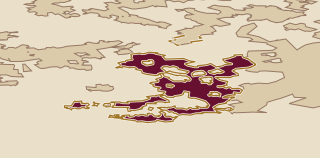
Villány occupies the southernmost edge of Hungary's recognised wine regions, sitting close to the Croatian border where the Villány Hills push up from the surrounding plain. Summers are warm and long, ripening Cabernet Franc and Cabernet Sauvignon to levels that are difficult further north. The PDO designation carries legal weight: it defines three quality tiers and sets minimum oak-ageing requirements for each. At the Premium tier, reds must spend at least a full year in oak. The Super Premium designation, reserved for Cabernet Franc alone, requires two years of ageing with a minimum of one year in wood. Those rules mean the label on a Villány bottle tells you something concrete about how long the wine has been in the cellar.
In the cellar
Vineyards and cellar
Vineyard work covers approximately 15 hectares across three sites. Kékfrankos, the Hungarian red grape known as Blaufränkisch in Austria and Germany, grows alongside the international varieties. Portugieser, usually a light early-drinking red, appears in a barrel-aged, vineyard-selected version at Jackfall, which is uncommon for the variety.
In the cellar, the Cabernet Franc protocol defines the house approach. Spontaneous fermentation using only native yeasts means no inoculant is added; the wine ferments at its own pace through the ambient microbial population. Ageing runs for 12 months in older 500-litre Hungarian barrels. Larger barrels mean slower, gentler oxygen contact than a standard 225-litre barrique; older wood means the barrel contributes almost no new oak flavour. The wine's fruit, pepper, and herbal character come from the grape and the site, not from the wood. At 12 months, the Cabernet Franc sits below the two-year threshold required for Super Premium classification, placing it in the Premium tier under Villány PDO rules.
Wines to know
The range in view
Jackfall's range runs from parcel-labelled reds through named-variety bottles. The two parcel names signal the clearest sensory differentiation within the estate's output.
Cseresznyés is a concentrated red with a ruby and violet colour and aromas built around ripe cherry, plum, blackberry, and blueberry. The profile is more blue-fruited and aromatic than soft, with colour depth and mid-palate density that suggest the limestone-influenced parcels.
A useful way in
A bottle to begin with
The Cabernet Franc is the bottle that carries the most of what Jackfall is doing differently. It ferments on native yeasts, which means no selected commercial inoculant shapes the fermentation. It ages for 12 months in older 500-litre Hungarian barrels, which means the oak presence is gentle and integrative rather than flavour-adding. On the palate: ripe blackberry and crunchy cranberry, pepper and herbs, then charcoal, smoke, cocoa, and warm wood on a long finish. The acid line is clean and the tannins are firm without hardness. Start here to understand what Villány limestone and loess do to Cabernet Franc when the cellar does not get in the way.