
Why it matters
The producer
Jaume Serra sits on the hill of El Padruell above Vilanova i La Geltrú, where the land drops toward the Mediterranean and the coastal air reaches the vines before the sea disappears behind the ridge. Most Cava is made inland, on the plateau of the Penedès. This estate grows its grapes at the coast.
The walled enclosure on the hill dates to 1647. It spent more than three centuries as a fortified country property before anyone planted vines across its hillside. A modern winery opened in 1986. The García Carrión family, one of Spain's largest wine groups, acquired the estate in 1997 and have run it since, with Jaume Serra remaining a distinct brand under their ownership.
Place and vineyards
Where the wines begin
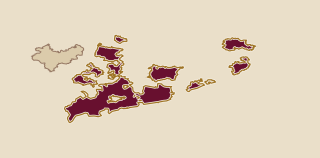
Vilanova i La Geltrú is a coastal town in the southern Barcelona province, where the Penedès wine country meets the sea. The Cava DO covers a large part of Catalonia, but most of the appellation's production is centred on the inland Penedès towns of Sant Sadurní d'Anoia and Vilafranca del Penedès, well away from the coast.
El Padruell faces the Mediterranean on a slope that funnels sea breezes through the vineyard. Coastal exposure moderates summer heat and introduces saline air during ripening. The official label for all sparkling wines made here is Cava DO, the national appellation that covers traditional-method sparkling wine produced in approved Catalan and other Spanish zones. Within that broad designation, the estate's coastal hillside position is the physical fact that separates it from the Penedès plateau norm.
In the cellar
Vineyards and cellar
The estate grows the four principal Cava grapes across its 125 hectares: Macabeo, Xarel-lo, Parellada, and Chardonnay. Each contributes differently to the Reserva blend. Macabeo lifts aroma and freshness. Parellada adds floral delicacy and acidity. Xarel-lo brings weight and body. Chardonnay rounds the mid-palate and extends the fruit range toward stone fruit and cream.
Red varieties on the estate, Cabernet Sauvignon, Merlot, and Tempranillo, go into still wine production. The cellar holds 6,000 American and French oak barrels for ageing those still wines.
Wines to know
The range in view
The sparkling range runs from accessible entry-level Cava to the longer-aged Reserva. Two bottles anchor the range.
The Pata Negra Brut is the fresh, fruit-led tier. Green apple, cracker, nougat, grapefruit, and herbs on the nose and palate. It is made for early drinking and carries a youthful mousse and direct fruit character without extended lees ageing.
A useful way in
A bottle to begin with
The Jaume Serra Brut Nature Reserva is the bottle to open first. It is a four-grape traditional-method Cava with no added sugar at disgorgement, minimum 16 months on lees, and a dry, fruit-forward palate built from Parellada, Macabeo, Chardonnay, and Xarel-lo grown on a coastal Mediterranean hillside. The brioche on the nose comes from the lees contact, not from oak. The green orchard fruit comes through clearly on a clean, balanced palate. It is an accessible introduction to what zero-dosage Cava from a single estate can be: honest, dry, and straightforwardly good.