
Why it matters
The producer
João Portugal Ramos spent two decades teaching other people how to make wine before he made his own. He trained in agronomy in Lisbon, completed post-graduate work in viticulture at the National Winegrowing Station in Dois Portos, and by 1980 was working as a consulting oenologist. Through Consulvinus, the practice he founded in the late 1980s, he advised estates across the Douro, Vinho Verde, Beiras, and Alentejo simultaneously, pushing low yields, selective harvesting, and measured oak ageing into operations that had never attempted them. The New York Times compared his influence over Portuguese winemaking to that of Piero Antinori or Emile Peynaud.
Ramos founded Consulvinus in the late 1980s at a moment when most Portuguese wine production was sold in bulk, and the idea of low-yield, oak-aged, variety-labelled bottles from indigenous grapes was far from standard. He was walking into estates that had never separated parcels, never tracked yield per vine, and never aged wine in small casks. The consulting years were, in effect, a long rehearsal for what he would do on his own land.
Place and vineyards
Where the wines begin
Alentejo stretches across the high plains of southern Portugal between the Tagus and the Algarve, a landscape of cork oaks, olive groves, and schist and clay-limestone soils baked by a continental Mediterranean climate. Summer temperatures regularly exceed 35°C, and rainfall is concentrated in winter. Those conditions favour thick-skinned red varieties that can ripen fully without losing colour or tannin, and the Alentejo is predominantly red wine country.
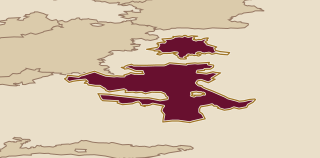
Estremoz sits in the northern Alentejo.
In the cellar
Vineyards and cellar
The 500 Alentejo hectares are planted to the indigenous red varieties that dominate warm southern Portugal: Aragonez, which is the Alentejo name for Tempranillo, gives firm tannin and red fruit with good colour retention in hot conditions; Trincadeira contributes darker berry character and spice when yields are low; Alicante Bouschet, a teinturier variety with red flesh rather than white, adds depth of colour and a plummy density to blends. White parcels are planted to indigenous white varieties typical of the Alentejo region.
Farming across the estate targets low yields, with selective harvesting to separate parcels by ripeness and potential. In the cellar, oak ageing is calibrated by tier to preserve grape character. Quinta da Viçosa is certified organic and farmed to that standard across all 40 hectares.
Wines to know
The range in view
The range runs across four labels, each occupying a distinct place in terms of fruit source, oak weight, and price.
Marquês de Borba is a main label from the Borba subregion of Alentejo.
A useful way in
A bottle to begin with
Marquês de Borba is a main label from the Borba subregion of Alentejo, drawing on indigenous varieties and calibrated oak aging.