
Why it matters
The producer
Gary Jordan is a geologist. Kathy Jordan is an economist. That combination runs through almost every decision the estate has made since they took over in 1993, from how the vineyard blocks are positioned across the hillside to which varieties go where on a 164-hectare property that had already been farmed for more than 300 years when the family first arrived.
Gary's parents, Ted and Sheelagh, bought the Stellenbosch land in 1982. Gary and Kathy did not move straight in. They spent two years working in cellars abroad before coming back to build their own in 1992. The first Jordan vintage followed in 1993. The property they returned to sits at the confluence of two ocean systems, which shapes every aspect of the fruit the estate grows.
Place and vineyards
Where the wines begin
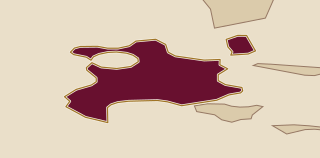
Stellenbosch is the wine heartland of the Western Cape, roughly an hour southeast of Cape Town, sitting between the Atlantic-facing slopes of the Cape Peninsula and the warmer inland valleys. Jordan's vineyards occupy a specific corner of that appellation where both ocean systems make themselves felt. The Indian Ocean, lying to the southeast, and the Atlantic, to the west, send competing cooling currents across the hillside from late afternoon onward. The estate has a Mediterranean climate with maritime influence: warm enough to ripen Cabernet Sauvignon and Syrah fully, cool enough to keep acidity alive in Chardonnay and Riesling.
That dual-ocean exposure changes the label calculus. A producer in a purely continental Stellenbosch position might concentrate on red varieties. At Jordan, whites carry equal billing because the site can support them. The Nine Yards Chardonnay is the clearest example: the coastal cooling preserves the acid line that French oak and lees contact would otherwise overwhelm.
In the cellar
Vineyards and cellar
The 164 hectares carry nine varieties spread across blocks that span the full altitude range. Chardonnay, Sauvignon Blanc, Chenin Blanc, and Riesling occupy the cooler, higher-altitude and south-facing blocks where slower ripening gives each grape its acid edge. Cabernet Sauvignon, Cabernet Franc, Merlot, and Syrah take the warmer positions lower on the slope, where longer afternoon sun builds the tannin and concentration the red varieties need. Assyrtiko, an unusual inclusion in a South African cellar, points to Gary and Kathy's willingness to test varieties against site rather than following regional convention.
In the cellar, the Nine Yards Chardonnay is handled with French oak, which gives the wine its toasty, spiced mid-palate. The oak is balanced rather than dominant: the citrus core and coastal acidity hold their line through the wood. Lees contact adds the creamy texture and the beeswax and lemon curd notes that Decanter's reviewers specifically identified. The overall approach is close to the Burgundian model: use the wood to build complexity around the fruit, not to replace it.
Wines to know
The range in view
Jordan's range is organised by grape and by degree of oak treatment. Chardonnay appears at three levels. The Unoaked Chardonnay is a direct, unwooded expression of the fruit from the cooler blocks: clean citrus, no oak character. The Barrel Fermented Chardonnay introduces French oak but at a lighter touch than the flagship. The Nine Yards Chardonnay is the top expression, with full French oak treatment and extended lees ageing, giving it the butterscotch, clove spice, lemon and lime, and orange peel profile on the nose, and a rich, layered palate through to a long peach and melon finish.
Sauvignon Blanc runs across two bottles. The Outlier and the Cold Fact suggest different picking windows or vineyard positions, though the exact separation is defined by the label names rather than a stated production difference.
A useful way in
A bottle to begin with
Start with the Nine Yards Chardonnay. It is the wine where every element of the Jordan estate converges: the altitude-varied site, the dual-ocean climate, and a cellar approach that uses French oak and lees contact to build around fruit rather than over it. On the nose, butterscotch and clove spice from the wood, lemon and orange peel from the Chardonnay, and a quiet oyster shell minerality that arrives from the coastal air. On the palate, rich and full, with a long peach and melon finish and enough acidity to keep the whole thing from feeling heavy. Decanter rated it 94 points and placed it in the Burgundian idiom.