
Why it matters
The producer
Kaapzicht Estate farms the Bottelary Hills ward of Stellenbosch with two plantings that define everything else about the estate: a Pinotage vineyard put in the ground in 1959 and a Chenin Blanc block planted twelve years earlier, in 1947. Most wineries that talk about heritage are pointing at an old cellar or a well-known family name. Kaapzicht points at vines.
The Steytler family name has been in the Cape since 1766, when a German ancestor first put roots down here. Major David Steytler, a post-war veteran, acquired Rozendal farm in Bottelary in 1946 and pivoted entirely: he traded a life as a Karoo sheep farmer for viticulture on a hill that would eventually carry two of South Africa's most significant old-vine plantings. The estate today spans 160 hectares across more than 21 grape varieties, with fourth-generation winemaker Danie Steytler Jnr leading the cellar since 2009 after studying viticulture at Stellenbosch University and working harvests in France, New Zealand, and California.
Place and vineyards
Where the wines begin
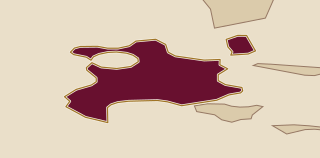
Bottelary Hills sits in the cooler, more windswept corner of Stellenbosch, where the Atlantic influence off False Bay moderates what would otherwise be a very warm growing season. The ward occupies elevated terrain away from the valley floor, with morning mist and afternoon winds that slow ripening and hold acidity in the fruit.
Bottelary Hills Pinotage grows denser and more concentrated than either of its parent varieties, Pinot Noir and Cinsault, while the cooler air keeps the red fruit character defined rather than cooked. The ward address on a Kaapzicht bottle signals a style: inky, dense, earthy rather than broad and sweet.
In the cellar
Vineyards and cellar
The estate farms more than 21 grape varieties across 160 hectares, with Pinotage and Chenin Blanc carrying the most historical weight. Old-vine Pinotage from the 1959 planting produces fruit with the density and spice concentration that Bottelary Hills is capable of at its most serious.
The 1947 Chenin Blanc is made with a method that reflects how much confidence the cellar places in old-vine fruit. Grapes from the 1.1-hectare block are whole-bunch pressed at 0.8 kPa, a very gentle extraction that preserves aromatic delicacy. Fermentation is spontaneous, using native yeasts, in 500-litre barrels and ceramic amphorae over two to four weeks. The wine then matures for ten months across 28% new oak, 50% second-fill oak, and 22% ceramic amphorae before being bottled unfiltered and unfined. That combination of gentle press, ambient yeast, and mixed-vessel ageing produces a Chenin Blanc with textural complexity that cannot be manufactured from younger vines.
Wines to know
The range in view
The Steytler range includes Steytler Pinotage, a single-variety red from old Bottelary Hills vines, cherry and red fruit on the nose with inky and vanilla undertones, a spiced and rich palate, and an earthy finish with good length. Technical data shows 14.72% alcohol, 5.8g per litre acidity, and a cellaring window of ten to fifteen years from vintage.
Steytler Vision is a Cape Blend built around Pinotage and was the first wine of that category to win Decanter's best red wine in the world award, for the 2001 vintage.
A useful way in
A bottle to begin with
Start with the 1947 Chenin Blanc. It is from 1.1 hectares of vines planted in 1947, the second-oldest surviving Chenin Blanc vineyard in South Africa. The wine uses whole-bunch pressing, ambient yeast fermentation in barrel and ceramic amphora, ten months of mixed-vessel ageing, and no filtration or fining. It opens with citrus peel and orange blossom and moves through almond and flinty reduction to a saline, textured palate with a long savory finish. It is dry in all the ways that matter: no sweetness lingers, no oak dominates, and the fruit's density translates into length rather than weight. The 1947 Chenin Blanc comes from Kaapzicht's second-oldest surviving Chenin Blanc block.