
Why it matters
The producer
In 1999, George Karimalis and his wife Eleni closed their working lives in Athens and sailed back to Ikaria with one clear intention: to farm a piece of land their family had never stopped owning. The vineyard they returned to had been in continuous cultivation for five centuries. It had not been abandoned; it had been waiting.
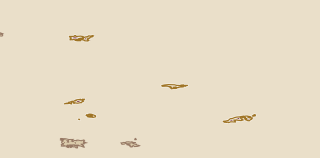
The estate sits on Ikaria, a mountainous Aegean island roughly halfway between Samos and Mykonos. The vineyard covers 3.5 acres and is planted entirely with indigenous grape varieties. All wines carry the PGI Ikaria designation, a Protected Geographical Indication that covers wines produced from grapes grown on the island. Fermentation uses only indigenous yeasts, and the estate describes its winemaking as minimal intervention.
Place and vineyards
Where the wines begin
Ikaria lies in the northeastern Aegean, closer to the Turkish coast than to the Greek mainland. It is a mountainous island with volcanic soils, a maritime climate tempered by altitude, and enough remoteness that its grape varieties have developed independently of the commercial pressures that reshaped wine production elsewhere in Greece.
The PGI Ikaria designation covers wines made from grapes grown on the island and labelled as such. It is not a prestige classification but a geographic signal: these grapes come from one specific Aegean island, from varieties that have grown here rather than varieties imported to fill a commercial gap. Ikaria sits outside the main denominational zones of Nemea, Naoussa, or Santorini. It operates on a smaller, less-known scale, which is precisely why the indigenous grape argument carries weight. The varieties here are not found in broader Greek production.
In the cellar
Vineyards and cellar
The vineyard is planted entirely to indigenous varieties. These are not the pan-Greek commercial varieties found across multiple appellations; they are grapes specific to Ikarian cultivation, including Fokiano and Begleri as candidates, though the full confirmed variety list is not available from current sources. Indigenous varieties on a small island evolve under local selection pressure over centuries and carry flavour and structural signatures absent in transplanted material.
Fermentation is carried out using indigenous yeasts drawn from the vineyard itself. This is not a stylistic preference alone; it is a decision to let the microbial population of the island carry the wine through conversion rather than introducing laboratory strains that would smooth differences away. Indigenous yeast fermentations run less predictably than inoculated ones, require closer monitoring, and produce wines that sit closer to their site of origin in character.
Wines to know
The range in view
All Karimalis wines carry PGI Ikaria and are made from indigenous varieties grown on the estate's 3.5 acres. The range is small by necessity: a vineyard of this scale, farmed organically and vinified without shortcuts, does not produce large volumes. What it produces is specific to the island.
Fokiano is an Ikarian red grape, capable of producing wines with concentrated colour, moderate tannin, and a fruit register that leans toward darker berries rather than the bright, high-acid red fruit profile associated with, say, Xinomavro in northern Greece. Begleri appears as a white or rosé candidate in the range. Both varieties are cultivated on this island in forms not widely seen in broader Greek wine production.