
Why it matters
The producer
Jamie Kutch left a NASDAQ trading career in New York before turning thirty and moved to California with Kristen Green to build a life around agriculture and wine. The first Kutch release, the 2005 vintage, amounted to 150 cases. That small beginning still describes the scale of the range: a focused group of Pinot Noirs and Chardonnays, sourced from coastal vineyards and kept close to their individual sites.
Kutch Wines is the producer; Sonoma Coast and Santa Cruz Mountains are the supplying AVAs; Pinot Noir and Chardonnay are the principal grapes. Regional bottlings introduce the coastal frame, while single-vineyard wines separate one maritime site from another. Jamie leads viticulture and winemaking, and Kristen works in public relations and estate development.
Place and vineyards
Where the wines begin
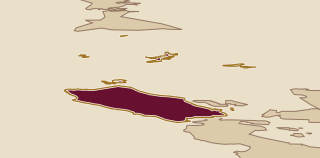
The Sonoma Coast and Santa Cruz Mountains are cool maritime California AVAs, where ocean influence slows ripening. In the bottle, that setting supports preserved acidity and keeps site differences visible across the range. Pinot Noir carries its place through fruit, perfume, tannin and finish, while Chardonnay carries it through acidity and lees texture.
The geography also explains why Kutch does not treat California as one uniform source. A single-vineyard Pinot Noir from the Sonoma Coast and one from the Santa Cruz Mountains can share a cool-climate profile while differing in fruit, perfume and the feel of the finish.
In the cellar
Vineyards and cellar
Vineyard work prioritizes dry farming, canopy management, biodiversity, soil health and reduced artificial inputs. Those choices keep attention on the condition of the vines and the pace of ripening before harvest. Old vines and heritage blocks receive particular value because their fruit is used to carry site character into the finished wine.
In the cellar, grapes are carefully sorted, handled gently and moved by gravity. Punch downs are performed by foot, while primary fermentation uses indigenous yeast and malolactic fermentation uses native bacteria. Pinot Noir fermentations often include whole-cluster elements, bringing perfume and tannin into the wine through the stems and skins.
Wines to know
The range in view
The range has two levels of address. Regional Pinot Noir and Chardonnay present the broad coastal California picture, while single-vineyard bottles narrow the view to places such as Mindego Ridge, Bohan Salt Point and Trout Gulch. The grape and site stay together on the label, so the range can be compared by both variety and vineyard.
Pinot Noir bottlings show red fruit, perfume, whole-cluster tannin, fine-grained texture and a persistent finish. Chardonnay bottlings such as Trout Gulch and Bohan Salt Point work through acidity, cool maritime fruit, lees-derived weight, mineral detail and an oak-free finish. Neutral French oak and long fine-lees ageing give both grapes room to show their vineyard differences.
A useful way in
A bottle to begin with
The 2023 Sonoma Coast Pinot Noir is the most useful first bottle because it presents Kutch's coastal starting point without narrowing the view to one named parcel. It is Pinot Noir from a cool maritime AVA, handled with native fermentation, frequent whole-cluster practice and ageing in neutral French oak on fine lees. Expect red fruit and perfume at the opening, followed by lifted acidity, measured tannin and a clean, persistent finish. It gives the broad regional frame before a Mindego Ridge or Bohan Salt Point bottling takes the comparison deeper into individual vineyard character.