
Why it matters
The producer
Pizzolato is an organic Prosecco estate in Villorba, a flat stretch of Treviso province where the Veneto plain spreads out toward the Piave River. The family has farmed this land for multiple generations, and for most of that time the business ran the way most Treviso producers ran: grapes sold in bulk, no label, no export ambition. Settimo Pizzolato changed that.
He joined his father Gino in 1981 and pushed the estate toward organic viticulture four years later, well before organic wine had a commercial market in Italy. By 1991, Settimo had obtained both European and USDA NOP certification, making Pizzolato one of the first Italian estates to hold a foreign organic standard. That certification date is the one the estate leads with today.
Place and vineyards
Where the wines begin
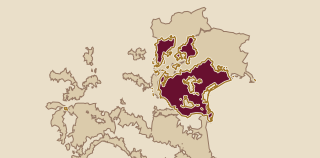
Villorba sits on the Veneto plain in Treviso province, low and flat, with the Piave River to the east and the Dolomite foothills visible to the north. This is Prosecco DOC territory, the broader plain-based appellation that covers Treviso and several surrounding provinces. It is not Prosecco Superiore DOCG, the hillside designation centred on Conegliano and Valdobbiadene, where steeper slopes and clay-limestone soils push yields down and concentration up.
On the plain, conditions favour volume: mechanisable rows, consistent warmth, longer growing seasons. Pizzolato's differentiator within this geography is not site complexity but farming discipline. Where most Prosecco DOC production at this scale relies on conventional viticulture, Pizzolato has held every hectare, owned and partner-sourced, to certified organic standards for over three decades. That decision shapes the label, the price point, and the export argument.
In the cellar
Vineyards and cellar
All 106 hectares, estate and partner, are farmed without synthetic pesticides, herbicides or fertilisers. Organic viticulture in the Veneto plain requires active management of vine disease pressure, particularly downy and powdery mildew, which are common in humid, low-altitude growing conditions. The commitment to hold partner growers to the same standard as estate rows is the structural choice that keeps the certification coherent at scale.
Glera for Prosecco DOC is hand-harvested and fermented by the Charmat method: secondary fermentation takes place in pressurised stainless-steel tanks, held at temperature-controlled conditions for approximately 30 days, reaching around 2.5 atmospheres of pressure for the frizzante style. Charmat is the standard method for Prosecco DOC across the appellation; Pizzolato follows it rather than the rarer traditional method. The tank fermentation preserves Glera's primary aromatics: white flowers, fresh pear, acacia blossom. No oak contact. The still wines, including Pinot Grigio, Chardonnay, Merlot, Cabernet, Pinot Nero, Moscato and Raboso, are vinified in stainless steel to keep fruit clarity across the range.
Wines to know
The range in view
The Pizzolato range divides into three groups: Prosecco DOC, organic still wines, and the M-Use collection.
The core Prosecco DOC line runs in two forms. The Prosecco DOC Frizzante is 100 percent Glera, hand-harvested, Charmat method, with a gentle mousse and a nose built on acacia blossom and white flowers. The palate is fresh, lightly pear-driven, and clean, with pleasantly firm acidity keeping the finish dry. The Prosecco DOC Spumante uses the same Glera base but runs at higher pressure, giving a livelier, more persistent bead and a slightly fuller mousse on entry.
A useful way in
A bottle to begin with
Start with the Pizzolato Prosecco DOC Frizzante. It is 100 percent Glera from certified organic Veneto vineyards, fermented in temperature-controlled stainless-steel tanks for around 30 days, bottled with a gentle mousse. The nose is white flowers and acacia blossom. The palate is fresh pear and clean acidity, with a dry finish and no oak contact anywhere in the process. It is not a complex bottle, and it does not try to be: it shows what organic Charmat-method Prosecco DOC tastes like when the farming is taken seriously and the fruit is handled carefully. At this price point, on the Treviso plain, that is the proposition.