
Why it matters
The producer
The Tessari family has made wine at La Cappuccina in Costalunga di Monteforte d'Alpone since 1890, farming the same volcanic hillside east of Verona across five generations. The estate sits inside the Soave DOC zone, and the current generation runs it as a working unit: Pietro, trained in oenology at Conegliano, leads the cellar; Elena manages marketing; Sisto, a Padua-trained agronomist, represents the estate abroad.
La Cappuccina became one of the earliest certified-organic estates in the Soave zone in 1985, committing to organic methods across every production stage from vine to bottle. Four decades on, Slow Wine reported the estate is now in biodynamic conversion. The same cockerel logo has appeared on their label since the family named the estate after the seventeenth-century Capuchin chapel attached to Villa Buri-Tessari.
Place and vineyards
Where the wines begin
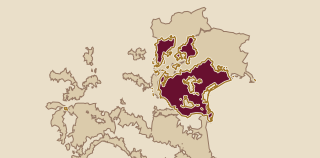
Soave DOC sits on the eastern edge of the Veneto, roughly thirty kilometres east of Verona. Within it, the Classico zone covers the older volcanic hills around Soave town, while Monteforte d'Alpone marks the eastern boundary where basalt soils dominate. Costalunga, where La Cappuccina's main parcels lie, belongs to this volcanic eastern band.
The Soave appellation is built around Garganega, a white grape that performs differently on volcanic basalt than it does on the alluvial plains to the south. On basalt, Garganega tends to give wines with firmer acidity, a savory edge, and a mineral quality on the finish rather than soft, broad fruit. The appellation allows Trebbiano di Soave as a blending component, and the label category carries through from the dry Soave DOC to the dessert wine tier, Recioto di Soave DOCG, which requires appassimento and produces a concentrated amber sweet wine from the same grape.
In the cellar
Vineyards and cellar
Vineyard work at La Cappuccina centres on low yields and soil health. Dense planting forces competition between vines, limiting individual vine vigour and concentrating flavour in the fruit. Cover crops and green manure build organic matter in the basalt soils. Short pruning limits the number of grape clusters per vine. Copper and sulphur replace synthetic fungicides.
In the cellar, the Soave is handled simply. The must settles at low temperature, ferments in temperature-controlled steel tanks, and then rests on its lees for approximately seven months before bottling. No oak, no additions. The lees contact adds texture and a savory depth to the wine without altering the grape's aromatic character. For Arzimo, the process is the opposite of speed: late-harvested Garganega is air-dried by appassimento, concentrated until four kilograms of fruit yield a single 500 ml bottle, pressed on Valentine's Day, then aged in oak barrels and further in bottle before release. The winery runs a photovoltaic system for energy, keeping the estate's environmental approach consistent from vineyard to building.
Wines to know
The range in view
The range at La Cappuccina moves across two main white categories and a set of red blends. Garganega is the thread that connects the most important bottles.
The Soave DOC is the estate's core wine, a dry white built on Garganega with Trebbiano di Soave. After seven months on lees in steel, it carries aromatics of white flowers, herbs, yellow fruit, citrus, jujube, and lychee, with a vibrant, savory finish that the producer describes as flinty. It is a wine for the table, not the cellar, though the lees contact gives it enough weight to hold its shape with food.
A useful way in
A bottle to begin with
Start with the La Cappuccina Soave DOC. It is a dry white Garganega, fermented in steel and held on lees for seven months, with no oak and no added sweetness. The wine gives you the basalt of Costalunga in the glass: white flower aromatics, yellow fruit, and a flinty, savory finish that stays clean and dry. Its weight sits between a lean Muscadet and a textured white Burgundy, substantial enough to take with food, light enough to work as an aperitif. Nothing about it is difficult. Buy one bottle to understand what Garganega does on volcanic soil when the farming is careful and the cellar stays out of the way.