
Why it matters
The producer
Lammershoek sits on the Paardeberg, a granite mountain that rises from the flat wheat and wine country of the Swartland in South Africa's Western Cape. The farm property dates to a 1714 land grant; the first vines went into the ground in 1719. What makes the address concrete today is eighty hectares of dry-land bush vines in decomposed sandstone, granite and clay, farmed without irrigation and focused on Chenin Blanc, Pinotage, Cinsault and a loose family of Mediterranean red varieties.
The cellar works with a low-intervention logic that has been in place since Craig Hawkins converted the farming to organic between 2010 and 2015. Schalk Opperman has been head winemaker since the 2015 harvest. Marius Kotze has run viticulture since 2018. Current owners Andreas and Sonja Abold have relocated from Europe to the farm and manage it directly. Three tiers of wine move from the Heritage Reserve range at the top through Mysteries to the Innocents at the approachable end.
Place and vineyards
Where the wines begin
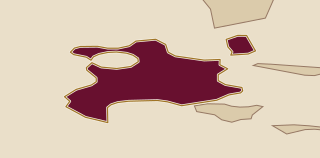
The Paardeberg is a granite intrusion that stands apart from the wider Swartland plain. Its soils are decomposed sandstone, granite and clay, giving root systems a reasonably deep, free-draining medium that stresses the vines just enough. The Swartland is warm, dry and windswept, and the Paardeberg sits within the Swartland Wine of Origin district. What the mountain provides that the flat inland does not is significant diurnal variation: daytime heat ripens the grapes fully, and the drop in temperature at night slows the final days of ripening and holds acidity in the fruit. That acidity is what keeps the wines from feeling heavy despite the warmth, and it is why the Pinotage and Chenin Blanc from these old dry-land vines can carry freshness alongside weight.
In the cellar
Vineyards and cellar
All vines are trained as bush vines and farmed without irrigation on their granite and sandstone soils. The organic conversion Hawkins completed between 2010 and 2015 removed synthetic inputs from the farming; viticulturist Marius Kotze has continued that approach since 2018.
In the cellar, the approach divides by grape. Half the Chenin Blanc goes through natural fermentation in old wood, picking up texture and complexity from the ambient yeasts and the porous surface of the older barrels without accumulating oak flavour. The Chardonnay component in at least one blend is aged in one hundred percent new wood, which adds a contrasting richness to Chenin-led blends.
Wines to know
The range in view
The range runs across three tiers with distinct jobs.
Heritage Reserve is the top level, built from the oldest parcels and the most careful cellar selection. It includes the Reserve Blanc, a Chenin-led white with old-vine depth; the Reserve Chenin Blanc; the Reserve Rouge, a red blend; and the Reserve Syrah. These wines carry more weight, more cellar complexity and longer potential than the tiers below. The Reserve Chenin draws from old-vine parcels and natural fermentation in old wood, giving it texture alongside the grape's characteristic acidity. The Reserve Syrah and Reserve Rouge bring in the Mediterranean variety character from the Paardeberg parcels: darker fruit, firmer tannin, and the kind of savouriness that comes from warm-climate farming on lean, dry soils.
A useful way in
A bottle to begin with
Start with The Innocent Pinotage. It is made from twenty-one and forty-two-year-old dry-land bush vines on the Paardeberg, fermented in open concrete tanks with a mix of whole-bunch and crushed-berry fruit, and aged ten months in those same concrete tanks before bottling. The nose gives cherry and raspberry without sweetness or extraction. The palate is juicy, the acidity bright, the tannin soft enough to disappear. It is not a complicated wine; it is a legible one. It shows what Lammershoek grows, what the cellar does with it when it works without oak, and what Pinotage can taste like when the winemaking gets out of the way of the fruit.