
Why it matters
The producer
Randall Grahm worked with Rhône varieties in California's Central Coast. He built Bonny Doon around that work. By 2021 he had arrived at a different and more uncomfortable conclusion: that pursuing a next generation of genuinely original California Rhône wines would be, in his word, essentially impossible for him to undertake alone.
So he called Gallo.
Place and vineyards
Where the wines begin
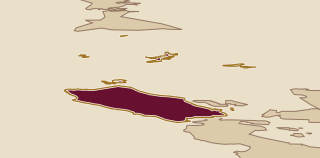
Santa Maria Valley sits at the southern end of California's Central Coast, roughly 200 miles north of Los Angeles, and its cold Pacific air distinguishes it from warmer inland growing areas. The valley runs east to west, funnelling marine influence directly into the vineyards. For Grenache, a grape that tips easily into jammy, high-alcohol fruit in warm sites, the cool diurnal swing here changes everything: harvests come in later, skins retain more acidity, and the finished wines carry a freshness and mineral edge that hotter-climate versions of the grape do not.
The Rancho Real vineyard, also known as Murmur, is the project's named source in that valley. Its fruit provides the backbone of the Grenache, and the cool-site character of Santa Maria shows in the salty mineral finish and the bright red-fruit acidity that the wine carries through to 2032.
In the cellar
Vineyards and cellar
The Rancho Real Grenache is assembled as 96% Grenache and 4% Syrah. Half the fruit undergoes whole cluster fermentation, meaning stems are included with the grapes rather than removed before fermentation begins. Whole cluster work extends maceration contact, slows the extraction of tannin, and adds a spice and herb character that destemmed fermentation does not produce. In a cool-climate Grenache, it also reinforces the savoury, mineral edge that the Santa Maria Valley already provides.
The wine ages for twelve months in a combination of used puncheons and stainless steel. Used puncheons contribute no new oak character; they add very gentle micro-oxygenation without leaving vanilla or toast on the wine. The stainless steel portion keeps the fruit precise and the acidity clean. The combination means the Grenache is shaped by the grape and the site, not by the barrel.
Wines to know
The range in view
The range is built around Rhône varieties from the Central Coast AVA. The documented flagship is the Rancho Real Santa Maria Valley Grenache, drawn from the Murmur vineyard and made as a 96/4 Grenache-Syrah blend with the whole cluster and air-drying approach described above. It is a medium-bodied red with grippy tannins, salty mineral character, and a drinking arc that extends to 2032.
The project also releases a rosé and a Syrah varietal under the same Central Coast framework, though production details and tasting profiles for those two wines are not publicly documented in a form that allows fair description here. The range is deliberately focused on Rhône varieties and places winemaking philosophy, including low-intervention cellar choices and named-vineyard sourcing, at the centre of its work.
A useful way in
A bottle to begin with
The 2022 Rancho Real Santa Maria Valley Grenache is the bottle. It is the only Language of Yes wine with full documentation and it carries every winemaking decision the project has committed to: cool-climate Grenache from a named Santa Maria Valley vineyard, half whole cluster fermented, air-dried for phenolic depth, aged twelve months in neutral oak and stainless steel. No new wood character. No excess weight. The strawberry and cherry on the nose give way to a savoury, mineral palate with grippy tannins and a long salty finish. It drinks now and holds comfortably through 2032. Start here.