
Why it matters
The producer
Matilde Poggi farms Corvina, Rondinella, and Garganega on the eastern shore of Lake Garda and has bottled wine under her own label since 1984. Before she started, the family sent their grapes to her father's brother, who ran his own winery. That arrangement ended with her first harvest.
The estate sits in Cavaion Veronese, inside the Bardolino DOC, a light-red appellation that sits between the lake and Valpolicella and has rarely drawn the kind of serious-collector attention its eastern neighbour commands. Poggi stayed there. She farmed organically, certified in 2009, and built a range that runs from an early-drinking red through a pale rosato, a single-parcel clos bottling, spontaneously fermented cement wines, and a varietal Garganega white. The estate name comes from the wild strawberries, fraghe in the local Venetian dialect, that grow among the vines.
Place and vineyards
Where the wines begin
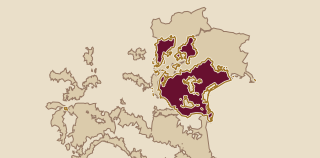
Bardolino DOC occupies a strip of the Veneto along the eastern bank of Lake Garda, in the province of Verona. To the west is the lake itself; to the east, the hills of Valpolicella begin. The appellation covers both a still red wine and its pale rosato counterpart, Bardolino Chiaretto.
The proximity of Lake Garda moderates temperatures through the growing season, cooling nights and extending ripening. The soils carry glacial material left when the glaciers that carved the lake retreated, producing a mix of schist, moraine, and mineral-laden subsoil. That combination points Corvina toward lighter body, bright acidity, and red-cherry fruit rather than the darker, richer profile of the Valpolicella hills to the east. Rondinella provides floral lift and colour support. Garganega, grown for the white Camporengo, brings waxy texture and almond-edged fruit on the same glacial base.
In the cellar
Vineyards and cellar
All grapes come from estate vineyards. Harvest is by hand. The farming is organic, certified since 2009.
In the cellar, Poggi works without oak throughout the range. The entry Bardolino and the Ròdon Chiaretto both ferment in stainless steel, preserving the aromatic directness of Corvina and Rondinella without adding weight. For the Ròdon, the varieties are vinified separately, macerated on skins for six to eight hours at cool temperature, then matured on fine lees in stainless steel until spring, giving the wine some texture alongside its pale colour.
Wines to know
The range in view
The range divides cleanly by grape, method, and ambition.
Le Fraghe Bardolino is the entry red: 80% Corvina, 20% Rondinella, fermented in stainless steel and released for early drinking. The colour is pale ruby, the body is light, and the tannin is low enough to serve the wine slightly chilled. Red cherry, a little dried herb, clean acidity.
A useful way in
A bottle to begin with
Start with the Ròdon Bardolino Chiaretto. It is a pale, dry rosato made from Corvina and Rondinella, the same grapes as the red Bardolino, but drawn off early and macerated cool before a long lees rest in stainless steel through winter and into spring. The wine is pale salmon, dry, and lively, with fresh red-cherry fruit, a light floral note from the Rondinella, and enough texture from the skin contact to hold the mid-palate. It is the clearest demonstration of what Corvina and Rondinella do when the cellar does not intervene with oak or extended maceration: aromatic, fresh, easy to pour again. The Bardolino appellation sits between Lake Garda and Valpolicella.