
Why it matters
The producer
Eugenio Campolmi planted Cabernet Franc and Syrah in Bolgheri before the region had decided what it wanted to be. In 1983, he and Cinzia Merli left the family business and bought four hectares on Via Bolgherese near Contessine, on the Tuscan coast south of Livorno. Bolgheri was beginning to attract attention for its Cabernet Sauvignon-led blends, but Eugenio was already thinking about single varieties.
The first commercial bottling came in 1987. Paleo Rosso debuted two years later as a Bordeaux-style blend before the estate committed it to Cabernet Franc alone. Three single-variety reds now form the spine of everything Le Macchiole does: Messorio from Merlot, Scrio from Syrah, and Paleo Rosso from Cabernet Franc. All three are sold as IGT Toscana, a classification that carries no geographic restriction beyond the region, because Le Macchiole's insistence on single-variety bottlings places them outside the Bolgheri DOC's blending requirements for red wines. The label says Toscana, but the wine is entirely Bolgheri.
Place and vineyards
Where the wines begin
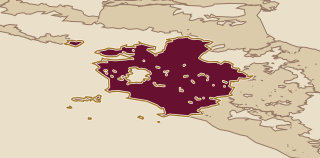
Bolgheri is a DOC on the Tyrrhenian coast of Tuscany, running inland from the sea toward the hills of the Maremma. The appellation sits within the commune of Castagneto Carducci, a hill town whose name honors the poet Giosuè Carducci, who spent his childhood in the area and made it famous in Italian literature.
The Bolgheri DOC builds its red wines around blends of Cabernet Sauvignon, Merlot, and Cabernet Franc, with minimum and maximum proportions that favour the Bordeaux varieties. An estate bottling 100% Merlot or 100% Cabernet Franc cannot use the Bolgheri DOC red designation; it becomes IGT Toscana instead. For Le Macchiole, three of its four main wines carry a broader regional label, not the appellation name. The trade-off is deliberate: the estate judges that each variety earns its own bottle, and a blend dilutes what the grape and the site are saying separately.
In the cellar
Vineyards and cellar
The estate runs at least 45 separate fermentations in a vintage. Each parcel goes through the cellar on its own schedule, and the decisions made at harvest, pressing, and fermentation reflect the individual plot rather than a house style imposed across the range.
Fermentation happens in stainless-steel and cement vats. Stainless steel holds temperature precisely and preserves primary fruit; cement adds a slight texture without oak character. Neither vessel adds flavour, which leaves the grape and the harvest doing the work through fermentation.
Wines to know
The range in view
The range has four main wines. Bolgheri Rosso is the entry-level DOC red, a blend that sits within the appellation's requirements and offers access to the estate's farming and cellar work at a lower price.
Above it, three IGT Toscana reds each carry a single grape. Paleo Rosso is 100% Cabernet Franc, the variety Eugenio planted early and which the estate eventually separated from its original Bordeaux-style blend. On the palate, the 2021 shows red fruit and blood orange, with coffee-derived notes, licorice, and exotic spice building behind them. The texture intensifies through the mid-palate, and the tannins are dense and assertive, finishing with some astringency. It is a firm, aromatic red that reads differently from the Cabernet Sauvignon-dominated blends the region is better known for.
A useful way in
A bottle to begin with
Start with Paleo Rosso. It is 100% Cabernet Franc from Bolgheri, aged 20 months in French barriques, and it is the wine that most directly demonstrates what Le Macchiole was arguing when Eugenio first planted the variety. The aromas are identifiably Franc: red fruit, citrus edge, some spice, a faint herbal note underneath. In the mouth, the tannins are firm and the finish carries that slight dryness that Cabernet Franc holds when it is grown in warmth and handled without over-extraction. It is not a soft wine, and it is not trying to be.