
Why it matters
The producer
Le Plan des Moines was founded by Daniel Orsolini, Thierry Pommet and Claude Serra, who brought almost 60 years of combined wine-trade experience to the project. Daniel had spent 20 years buying and selling wine internationally. Thierry began as a sommelier, works on blends and oversees European and American markets. Claude, a viticulturist, winemaker and professor of oenology at Montpellier University, controls viticulture, winemaking and bottling.
The division of work reaches directly into the bottles. Vineyard decisions and cellar work remain under Claude's control, Thierry tastes and blends with a sommelier's background, and Daniel brings experience from the commercial life of wine. The producer's first vineyard supplied the name, while the wines stay at the property from vinification through bottling.
Place and vineyards
Where the wines begin
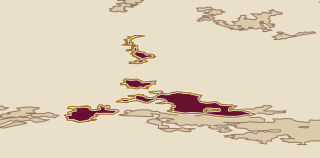
The first vineyard lies between Remoulins and Avignon and carries the Côtes du Rhône and Côtes du Rhône Villages appellation names. Those labels place the opening wines within the wider Rhône system. The later Châteauneuf-du-Pape wine comes from Les Charretons, a four-hectare vineyard at Courthézon. The range therefore moves from a first site identified through regional appellation names to a named vineyard inside one of the Rhône's more specific appellations.
The place names are part of the bottle's meaning. Côtes du Rhône and Côtes du Rhône Villages mark the beginning of the estate's work, while Châteauneuf-du-Pape records the Courthézon vineyard as a separate property and wine category.
In the cellar
Vineyards and cellar
The Châteauneuf-du-Pape holdings are listed as certified organic. Vineyard work also prioritises organic treatments, with average yields capped at 40 hectolitres per hectare. Grapes are traditionally hand-picked and carefully sorted, placing selection at the centre of the harvest before the fruit reaches the cellar.
The estate vinifies and bottles on the property, so grapes and bulk wine do not travel between separate facilities. Les Silènes gives the clearest named example of the cellar method: fermentation lasted five to six weeks, followed by at least eight months in traditional concrete vats protected from air. The concrete vessel and long maturation keep the wine's development tied to a controlled, enclosed cellar process.
Wines to know
The range in view
The confirmed range begins with Côtes du Rhône and Côtes du Rhône Villages wines from the first vineyard, then reaches Châteauneuf-du-Pape through Les Charretons at Courthézon. The bottles carry different appellation positions, while the cellar work keeps them within the same estate system.
La Borde 2013 supplies a fruit-led profile with crisp red fruit, blackcurrant jelly, raspberry and cedar. Fine, fleshy tannins give the palate weight, and a menthol-like note marks the finish. Les Silènes is the concrete-matured wine, with its five-to-six-week fermentation and minimum eight-month élevage giving it a distinct cellar character within the range. Le Pré des Suves 2013 records a blend of 70 percent Grenache, 20 percent Syrah and 10 percent Carignan, so those proportions belong to that vintage and not to every release.
A useful way in
A bottle to begin with
La Borde 2013 is the first bottle to open. Crisp red fruit leads into blackcurrant jelly and raspberry, with cedar adding a savoury edge. Fine, fleshy tannins give the middle palate a soft but present grip, and a menthol-like note remains after the fruit has faded. The bottle brings fruit, tannin, wood spice and freshness into one clearly described Rhône wine, making it the most direct starting point in the confirmed range.